Mozart's Bassoon Concerto, 19
Concluding Remarks
Comments
Practicing musicality and some technically difficult passages in the Concerto. By Terry B. Ewell, Bassoon Digital Professor.
The original transcript is available here.
Videos
Chapters
Transcript with Time Codes
00:00Introduction
Music: "Mozart Mashup" with Terry Ewell and Elaine Ross. Welcome, this is Terry Ewell. The manner and method with which you practice can be even more important than the amount of time you spend on the activity. For instance, in the last video, I presented the most important gesture in Mozart's Bassoon Concerto: the appoggiatura. The approach to the appoggiatura, the "lean in" of the appoggiatura ornament, and the departure from, or even resolution of the phrase all need to be practiced. The best way to perform musically is to practice playing musically at every moment. Don't view technique and musicality as separate components; rather seek to integrate them at all times.
01:17Building a Musical Gesture
Start by practicing just a few notes in each musical gesture. Here the example is from the retardation in the Third Movement. Music: two notes Then add a few notes before the gesture, making sure that these added notes are appropriate to the phrasing. Music: four notes Then add a few more notes. Music: seven notes
 Open full-size figure
 Open full-size figure
 Open full-size figure
02:02Completing the Phrase
However, this single phrase is not complete until the entrance after it is practiced as well. Often the ears are turned off during a breath and little attention is given to the accurate timing of the next entrance. Practice this with a metronome ensuring that the first F3, open F, occurs correctly on the beat. Then further attention is needed to make sure that the triplets are properly placed in the beat without a tempo change. Music: Mozart Third Movement, measures 43–44, phrase and start of next phrase Paying close attention to details such as these throughout the Concerto will greatly aid the final performance. Careful practice right from the start will avoid mistakes that need to be corrected later.
 Open full-size figure
03:05First Movement Sixteenth Notes
Now, let's turn our attention to a few difficult passages in the First Movement. One of the most difficult passages in the movement is best practiced with an understanding of the phrasing, the musical gestures. The Urtext edition contains no slurs, so I recommend adding the slurs given in red and continuing the pattern of two slurs and two tongued notes up to and including measure 54.
03:45Quarter-Note Reduction
This next figure shows the phrasing, the musical gestures. I suggest practicing slowly first with quarter-note values on the notes given in red. Music: Mozart First Movement, measures 50–55, Quarter-Note Reduction Notice that the notes in red are all the main notes of the phrases. The rest of the notes, the repeated B-flat threes, are accompaniment.
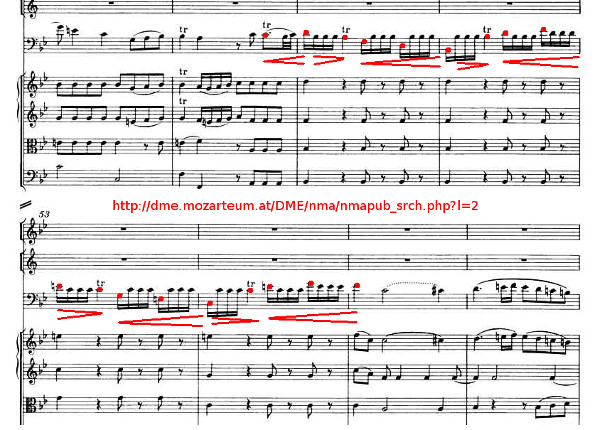 Open full-size figure
04:24Slurred Notes Reduction
Then practice the phrasing with just the slurred notes as given in this figure. Music: Mozart First Movement, measures 50–55, Slurred Notes Reduction
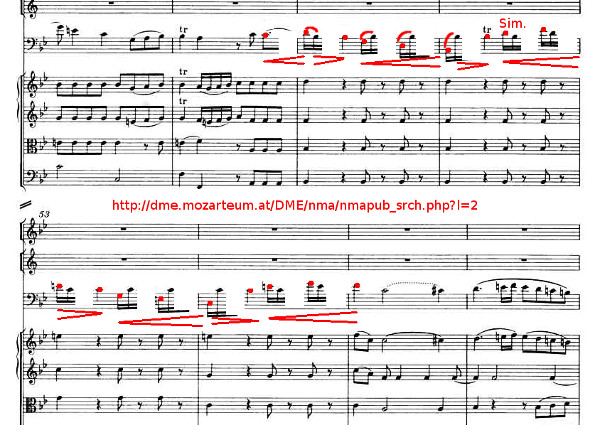 Open full-size figure
04:46Emphasizing the Beat
When you practice the passage as written, emphasize only the sixteenth notes on the beat. The B-flat three sixteenths that do not occur on beats must be played more lightly than the main notes. One way to do that is to lengthen the sixteenth notes on the beat slightly. This provides more stress on the notes. Music: Mozart First Movement, measures 50–55, No Trills
05:35Integrating the Trills
Notice that the trills are not stressed. This is often a mistake made by performers. Just because a note has a trill does not mean it should be more prominent than the musical phrasing requires. Make the trills part of the phrasing. Music: Mozart First Movement, measures 50–55, As Written
06:18Trill Terminations
I do not add nachschlagen, or terminations, to the trills in this passage except as printed in the music. Please see Video 5, BDP 216, for a discussion of the trills in the First Movement.
06:36The A-flat–B-flat Trill
The A-flat–B-flat trill in measure 145 is a problem. I have A-flat–B-flat trill mechanisms on both my Heckel bassoons, but I really don't like either. Usually I just play the full fingering with two alternations. Here, however, is a possible fingering for the trill that may work for you. Also, you can just do one shake: A-flat, B-flat, A-flat.
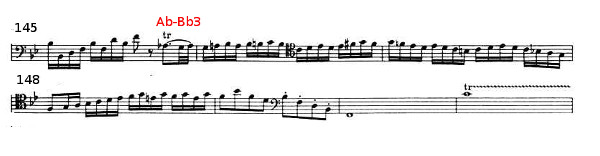 Open full-size figure
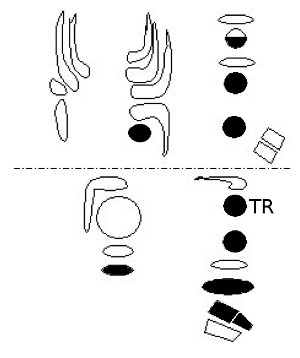 Open full-size figure
07:27Practice with the Accompaniment
Part of your practice time should be with the accompaniment. I realize that it is expensive to rehearse with a pianist, and no one that I know of has an orchestra available for all of their practice sessions. To help you out, I have prepared several MIDI and MP3 files of this concerto for your practice. The links are given at: https://www.2reed.net/bdp/home.html#Mozart Make use of the files frequently so that you know the accompaniment and how your part fits with it.
08:25Conclusion
Well, this concludes our nineteen videos on the Mozart Bassoon Concerto. I hope that the videos have aided your understanding of the Concerto and provided you with ways in which you can improve your performance of this important work. Thank you for viewing the videos. God bless you! Music: "Mozart Mashup" with Terry Ewell and Elaine Ross.
Credits
- author Terry B. Ewell
- Artwork and Graphics by Terry B. Ewell
- Copyright 2015-22 by Terry B. Ewell.
- Copyright (c) 2018 by Terry B. Ewell. All rights reserved.