Practicing Weissenborn Study #7
Performance and practice suggestions for Julius Weissenborn's Bassoon Studies, Opus 8, Study #7
Comments
Practicing Weissenborn Study #7 (2014, BDP #115). The public domain music for Opus 8/2 – 50 Advanced Studies is available here: Music from IMSLP | Alternate PDF
The original transcript is available here.
Videos
Captions are unavailable. The complete transcript follows.
Chapters
Transcript
00:21Review of Previous Techniques
This study provides another opportunity to practice several of the techniques we have learned in the earlier lessons. First, try to minimize the movement of your jaw when tonguing the arpeggios. The bassoon is much more forgiving of jaw motion than the oboe or clarinet. However, we should still strive to use efficient performance techniques. Play the arpeggios "on the wind." Let's look at this in more detail. Playing "on the Wind" https://2reed.net/bdp/home.html#bdp56
00:56Articulation Experiments
Every movement of the jaw changes either the pitch or the timbre of the note. I suggest that you review the "Articulation Experiments" presented in my Beginning Bassoon Lesson #3. English and Chinese https://2reed.net/bdp/home.html#bdp33 YouTube English: http://www.youtube.com/v/Zv20zy2O8Mo Chinese: http://youtu.be/CLKaB9cTCYg
01:11Five Tonguing Patterns
For many students, jaw movement interferes with varied tonguing patterns. Practice Study #7 using five tonguing patterns: 1–2–3–4–5. Begin with 5, which is legato tonguing. Then progress through the numbers, making each articulation shorter until you reach 1, which should be as short as possible. Here is Number 5. Example Here is Number 4. Example Here is Number 3. Example Here is Number 2. Example Here is Number 1. Example
02:28Mirror Practice
Practice in front of a mirror. The goal is for the embouchure to move no more than it does when playing the same passage slurred. Example Of course, the embouchure must move to adjust the intonation of each note. However, we are trying to avoid unnecessary movement during the note itself.
03:06Rapid Breathing
The second technique to practice is rapid breathing. The quickest way to breathe is by dropping the jaw. Most bassoonists breathe by raising their heads, which takes more time. See how quickly you can breathe so that you avoid interrupting the rhythm.
03:32Flick Keys
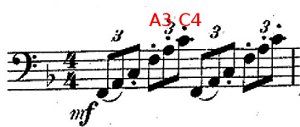
The third technique is the use of flick or venting keys. Please refer to the previous videos for the fingerings. When two consecutive notes both require flicking, you can simply hold down the C flick key. For example, in measure 1, on A3 and C4, hold down the C flick key for both notes. Example Also, in the first measure of the third line, hold down the C flick key for both B♭3 and C4.
 Open full-size figure
 Open full-size figure
04:26Reflection
REFLECTION And the LORD God commanded the man, saying, "Of every tree of the garden you may freely eat; but of the tree of the knowledge of good and evil you shall not eat, for in the day that you eat of it you shall surely die." (NKJV, Genesis 2:16–17) Expectations for performance are high in many areas of life. Eating the wrong fruit in the Garden of Eden changed the lives of Adam and Eve. Likewise, a single wrong note in a beautiful melody can diminish the entire melody. Study #7 is especially challenging because every note should be clear and clean. Strive to eliminate the bad notes, leaving only beauty.
Credits
- author Terry B. Ewell
- composer Julius Weissenborn