Practicing Weissenborn Study #8
Performance and practice suggestions for Julius Weissenborn's Bassoon Studies, Opus 8, Study #8
Comments
Practicing Weissenborn Study #8 (2014, BDP #116). The public domain music for Opus 8/2 – 50 Advanced Studies is available here: Music from IMSLP | Alternate PDF
The original transcript is available here.
Videos
Captions are unavailable. The complete transcript follows.
Chapters
Transcript
00:19Practicing Problem Areas
Welcome, this is Terry Ewell. These are my comments on Weissenborn Study #8. Many students always begin practicing a study or composition from the beginning. It feels good to play, over and over, the passages you already perform well. However, it takes greater courage to confront the most difficult parts of an exercise such as this. The quickest way to make progress is to identify the problems and devote more practice time to them. The most difficult sections of an exercise deserve more practice than the easier sections.
01:04Mark Difficult Passages
I suggest you try a new technique that will improve the efficiency of your practice. Sight-read Study #8 several times. Carefully note the passages that give you the greatest difficulty and mark them with an "X." You probably had little difficulty with measure 1. In fact, you may have played it well every time. Other places, however, such as the fourth line, probably earned one or two "X" marks. Decide this week to practice the problem spots first! Don't begin at the beginning. Read through the entire study only after you have worked carefully on the difficult passages.
01:53Three Practice Methods
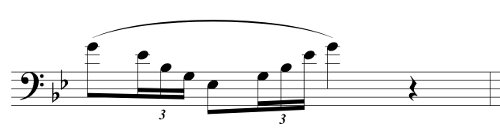
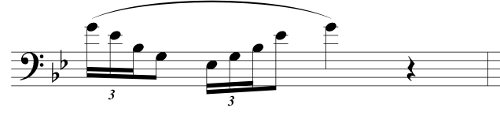
I tell my students that once they have identified a problem area, they should find at least three different practice methods to address it. Let's assume that line 4, measure 3 is a problem area for you. Here are some practice methods to consider.
02:13Rhythm Practice
We have already seen that rhythms can help improve finger coordination. Here are several rhythmic exercises and other patterns you can use for this passage.
 Open full-size figure
 Open full-size figure
 Open full-size figure
 Open full-size figure
 Open full-size figure
 Open full-size figure
 Open full-size figure
03:34Tonguing Sprints
Tonguing may also be a problem. Let's separate tonguing from finger technique. I call short bursts of tonguing or fingering patterns "sprints." Although slow practice is valuable for reinforcing proper technique and developing muscle memory, rapid playing cannot be mastered without practicing speed. Here is an exercise to increase tonguing speed. Be sure to push, or sprint, all the way to the end of the pattern. Do not slow down.
 Open full-size figure
 Open full-size figure
04:31Drones
Finally, let's do a little more work with drones. Since the first line of this study features two chords— the tonic and the dominant— we can use a drone on the fifth scale degree to help improve intonation. In B-flat major, the fifth scale degree is F. Listen to this example of slow practice of the first line with an F drone. Example: F Drone
05:17Reflection
"The unexamined life is not worth living." (Socrates, Apology 38a) Then the LORD God called to Adam and said to him, "Where are you?" (NKJV, Genesis 3:9) Too often we try to avoid our problems. As I mentioned in this lesson, students frequently avoid the most difficult passages in a musical study. We also tend to avoid difficult areas of life. Sometimes we even avoid thinking about life's challenges. However, hiding from problems does not make them disappear. It is difficult to examine the issues that are harmful to our lives. In music, identifying problems is the most efficient way to master an exercise. Likewise, confronting a problem in life is the best place to begin finding a solution.
Credits
- author Terry B. Ewell
- composer Julius Weissenborn