Weissenborn Study #22
Weissenborn Opus 8/2, Study #22 for advanced bassoon students. Beat displacement and the metronome. Guest performer Genesis Neely.
Comments
Weissenborn Opus 8/2, Study #22 for advanced bassoon students. Beat displacement and the metronome. Guest Performer Genesis Neely. By Terry B. Ewell, Bassoon Digital Professor. BDP #130.
The original transcript is available here.
Videos
Captions are unavailable. The complete transcript follows.
Chapters
Transcript
0:18Introduction and Rapid Breathing
Welcome, this is Terry Ewell.
0:21Section
This is another study where breathing rapidly is necessary in order to avoid delaying entrances in the music. Again I encourage you to breathe by dropping the jaw and not raising the head. I have discussed this in prior videos in this series.
0:40Clean Articulation and Flicking
Focus on clean articulations for each note. You will need to flick articulated A3, Bb3, B3, and C4 notes. Please refer to Studies 3 and 4 on flicking if you need to review flicking technique.
1:00Beat Displacement and the Metronome
Beat displacement is a great tool for practicing this study and the metronome is the best way to apply it. You probably haven’t thought about what a great tool the metronome can be for this study.
1:15Difficult Passage in the Second-to-Last Line
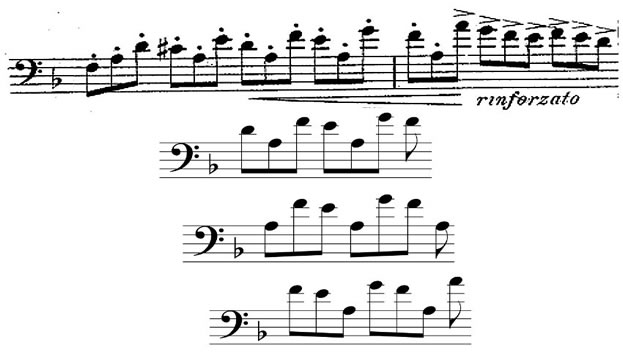
Let’s focus on the difficult passage in the second to last line. Several measures of the music are given in the top line. The first short segment coincides with the beat as written. In the second segment the beat is shifted one eighth note to the right. In the third segment the beat is shifted two eighth notes to the right.
1:44Practice Short Segments with the Metronome
Practice the short segments with the metronome:
 Open full-size figure
2:14Shifting the Beat
Even though the finger combinations remain the same, it is amazing how different the passage feels with the beat shifted. This is a great workout for your brain!
2:28Longer Segments
After you have mastered short segments, work on longer segments. In this way you can successfully perform the whole study. --- # REFLECTION
2:38Reflection: The Metronome
How any musician could ever play with a metronome, passes my humble understanding. It is not only an inartistic, but a downright anti-artistic instrument. — Constantin von Sternberg, Ethics and aesthetics of piano playing Metronome quotation reference
2:57Section
You can visit this website and read of many evils attributed to the metronome. Perhaps inflation, world wars, and famine could be fixed by abolishing that evil machine!
3:12Metrical Freedom and Rhythmic Precision
Well, indeed, it is disagreeable to hear a performance that provides no metrical freedom, one that is rhythmically shackled. However, my experience working with students is that it is far more likely for rhythms and tempos to be terribly askew than too metrical.
3:37The Metronome as a Practice Tool
The metronome is an instrument to be used to develop rhythmic precision. When that is mastered then you have a reference point from which to depart. It is a wonderful practice tool that builds the foundation for artistry.
3:56Three Reasons to Use a Metronome
I find the metronome indispensable for three reasons:
4:01Section
1. It is an aid for accurate tempos and rhythms.
4:08Section
2. It is a means of assessment. For instance, day by day you can chart your progress at performing a certain passage faster and faster.
4:23Section
3. It is a great tool to help with beat displacement.
4:28Keep the Metronome Handy
Keep your metronome handy while you practice and reach for it often!
Credits
- author Terry B. Ewell
- composer Julius Weissenborn