Weissenborn Study #23
Weissenborn Opus 8/2, Study #23 for advanced bassoon students. This contains information on volume, vibrato, and agogic accents.
Comments
Weissenborn Opus 8/2, Study #23 for advanced bassoon students. This contains information on volume, vibrato, and agogic accents. By Terry B. Ewell, Bassoon Digital Professor. BDP #131.
The original transcript is available here.
Videos
Captions are unavailable. The complete transcript follows.
Chapters
Transcript
0:18Grace Notes Before the Beat
Welcome, this is Terry Ewell. The grace notes at the beginning of Weissenborn study #23 are played before the beat. The slashes or slanted lines through the grace notes are an important indication of this. By the way, most grace notes in the Romantic period are placed before the beat.
0:40Rinsforzando
I have spoken earlier about the rF—rinsforzando--in Study #12. Please listen to my comments on this.
0:55Delicato and Two Types of Grace Notes
The most difficult section of the study for many students is the middle section which is mark Delicato means delicate. Study carefully the written notes above the staff provided by Weissenborn. These grace notes do not have slashes, but appear as smaller sixteenth notes. Thus, these are performed on the beat with the same rhythm and placement as written sixteenth notes. Notice that this middle section also has grace notes with slashes. The two types of grace notes will need to be played differently.
1:42Da Capo
This is the first da capo study in the set of fifty studies. When you repeat the first section again, do not play the repeats on the second time through.
1:54Fine
The word fine means “end” in Italian. This is where the etude concludes. --- # REFLECTION
1:59Reflection: Types of Accents
Consider accents—There is not just one type!
2:06Section
I have found an excellent summary on accents contained in Wikipedia. I encourage you to take a look at this: https://en.wikipedia.org/wiki/Accent_(music)
2:19Dynamic Accents
Musical artists must understand how to accent. One type of accent can be made with volume. These are called dynamic accents. There are different types of dynamic accents that vary in amplitude, speed, and placement.
2:35Faster Accents on the Beat
For instance, studies 22 and 24 require faster accents presented on the beat. There should be no delay or this will interfere with the rhythm and tempo of the studies.
2:48Section
Here are some accents in Study 22:
 Open full-size figure
Section, continued
Here are some accents in Study 24:
 Open full-size figure
3:13Gentle Accents and Delay
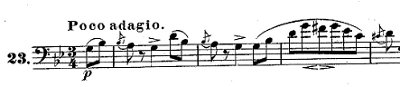
Other accents can be more gentle and with a slight delay. This is more appropriate in slower compositions such as Weissenborn 23. For instance, the accents in the first two measures can be performed like this:
3:43Vibrato Accents
Furthermore I can emphasize notes and thus accent them with increased vibrato. Perhaps we should call this a vibrato accent.
 Open full-size figure
4:00Agogic Accents
In Weissenborn 23 we get a chance to practice another kind of accent. An agogic accent is one of timing, placement, or duration. Instruments such as the harpsichord are unable to give different dynamics. Players of these instruments make use of agogic accents instead.
4:24Harpsichord Demonstration
Let’s go to my grandmother’s harpsichord for a demonstration. The harpsichord is an instrument in which you can’t make notes sound louder by pushing down the keys harder. The notes have the same volume no matter how you depress the keys. For this reason, harpsichord performers have developed very sophisticated applications of the agogic accent to bring out dynamics in music.
4:56Passage with No Accents
Here is a passage with no accents. Example G A B C D C B A G
5:05Agogic Accent of Length
Now here is an agogic accent of length on D (re). Example G A B C D C B A G
5:21Section
I didn’t vary the timing of the note only the length. The longer note makes the D sound louder and thus accented.
5:30Agogic Accent of Timing
Here is an agogic accent of timing. Example G A B C D C B A G
5:40Delay Gives Emphasis
The delay on the D gives the note emphasis.
5:51Agogic Accent in Weissenborn Study #23
The agogic accent with delay can be employed quite effectively on the Bb4 in the second page, second line. This is especially useful the very last time that B flat is played. Typically you want to play most expressively the last time.
 Open full-size figure
Credits
- author Terry B. Ewell
- composer Julius Weissenborn