Weissenborn Study #24
Weissenborn Opus 8/2, Study #24 for advanced bassoon
Comments
Weissenborn Opus 8/2, Study #24 for advanced bassoon students. Multiple practice methods for rapid passages are discussed. By Terry B. Ewell, Bassoon Digital Professor. BDP #132.
The original transcript is available here.
Videos
Captions are unavailable. The complete transcript follows.
Chapters
Transcript
0:18Introduction: A Finger Twister and Brain Strainer
Welcome, this is Terry Ewell. Weissenborn study #24 is a real finger twister and a brain strainer! It features descending and ascending thirds in E flat major.
0:35Six Practice Methods for a Difficult Passage
Let's consider line 6, the three measures before the fermata. My rule is that you need at least two ways to practice a difficult passage. But in this case I expect you to come up with at least six practice methods! I want you to stop the video now and write down all of the ways you can think of practicing these three measures.
0:57Comparing Practice Methods
OK, let's compare notes. If you have been watching all of the prior videos, you should have at least six ways to practice this passage. Here are some of the ways I developed to practice these three measures:
1:22Rhythms That Coincide with the Meter
Rhythms that coincide with the meter
 Open full-size figure
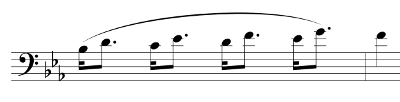 Open full-size figure
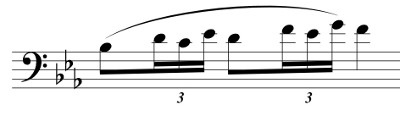 Open full-size figure
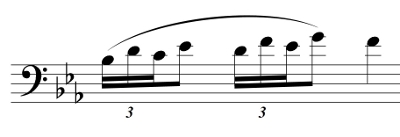 Open full-size figure
Rhythms That Coincide with the Meter, continued
Rhythms that don't coincide with the meter
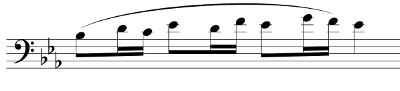 Open full-size figure
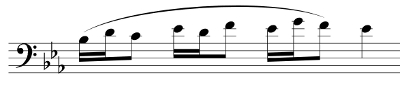 Open full-size figure
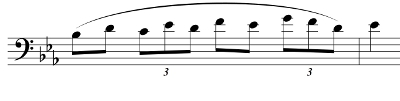 Open full-size figure
2:12Beat Displacement
Beat displacement
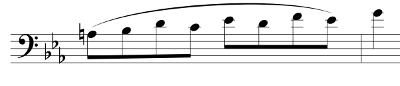 Open full-size figure
Beat Displacement, continued
Beat displacement with rhythms. Of course you can do all of the prior rhythms given earlier with beat displacement. Here is one example.
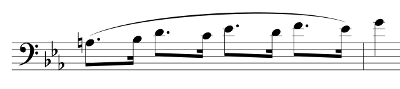 Open full-size figure
2:40Repeated Notes and Sprints
Repeated notes
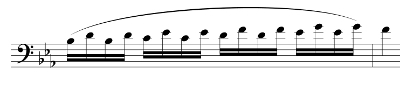 Open full-size figure
Repeated Notes and Sprints, continued
Sprints. Remember to practice small sections first. I mentioned in the earlier studies that it is best to start from the last measure first and then add the measures before it. For instance, practice the measure before the fermata first, then two measures before, and the three measures before.
3:12Additive Practice with Rhythms
Also use this additive method for your work with rhythms.
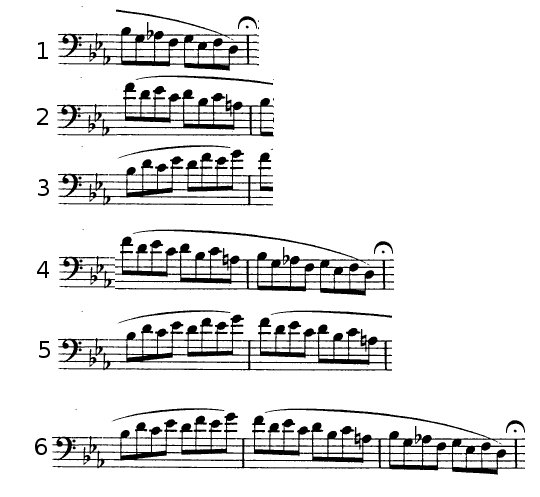 Open full-size figure
4:10Thinking of the Scale
I mentioned in Study 11 that it is helpful to think of the scale and allow the fingers to follow. This also helps with this difficult passage:
 Open full-size figure
4:34Focusing on the Problem Note
Sometimes the solution to a fingering problem lies with the way you think about the passage. In the second to last measure I continued to have difficulties until I fixed my attention on the problem note. For me the G2 is the key note. I greatly improved my accuracy by concentrating on that note. You might find similar issues with other difficult passages. The solution could be focusing on a certain finger motion in a key area or giving attention to a single note in a passage.
 Open full-size figure
5:07Practice for Success
Practice for success! Always end your practice sessions with successful performances. When you practice you will increase the difficulty (here the speed of the passage) until failure or mistakes occurs. Then reduce the speed until you are successful. Ending with successful repetitions will give you a positive attitude about the difficult passage.
5:36Alternate Eb Fingering
I use the alternate Eb fingering except for when the Eb3 starts a phrase:
5:43G3 Fingering and Intonation
Be sure to use the little finger key on every G3 to keep these notes in tune.
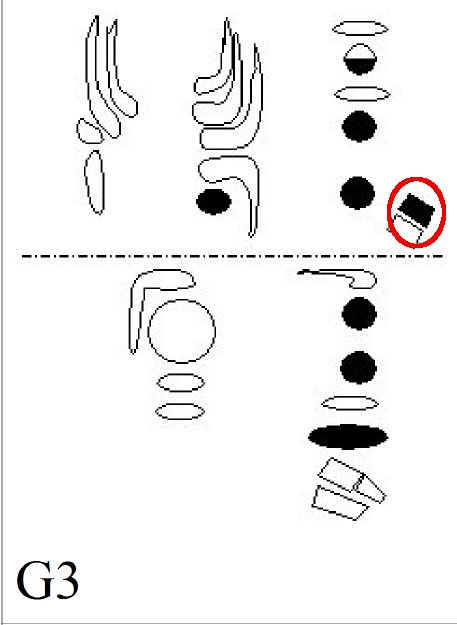 Open full-size figure
5:53Rallentando before Fermatas
Last of all, fermatas in the studies imply a rallentando prior to the fermata. I have included this in the music accompanying the edited performance. ------------------------------------------------------------------------ # REFLECTION
6:08Reflection: Increasing the Intensity of Practice
In weight training, you can't just keep doing the same thing. Somewhere along the line, you have to train with more intensity. Either you need to lift more weight, to go through your routine at a faster pace, to add more exercises to your program--or all of the above....
6:31Improving Practice Methods
I challenge you to consider how to improve all aspects of your life. Be your best! When you practice bassoon, don't keep doing the same things over and over again. Consider if there are superior and more efficient ways to practice and improve your bassoon technique.
6:55Rapid Fingerings, Oxygen Regulation, and Concentration
In study 24 there are two problems: one of rapid fingerings and one of oxygen regulation and concentration. You need to adopt efficient ways to move your fingers. I have prepared a video on fingering technique (BDP#23) that will be helpful for you. In particular advanced players need to pay attention to the end of that video (5:20 and onward). BDP #23 Fingering Technique on YouTube BDP #23
7:28Breath Control, Relaxation, and Endurance
The second issue of breath control, oxygen regulation, and better concentration will be mastered in several ways. Learn to relax your whole body when you play. Use only efficient motions because this will increase your lung capacity and provide a more efficient use of oxygen. Efficient breathing and exhalation will also improve your playing. My monograph "Wind Performer's Guide to Increasing Endurance" provides information on efficient breathing and several exercises to increase performance endurance. It is available on lulu.com. Wind Performer's Guide to Increasing Endurance
Credits
- author Terry B. Ewell
- composer Julius Weissenborn