Weissenborn Study #37
Weissenborn Opus 8/2, Study #37 for advanced bassoon
Comments
Weissenborn Opus 8/2, Study #37 for advanced bassoon students. Shaping the phrase through tongued notes. My encounter with God, part B. By Terry B. Ewell, Bassoon Digital Professor. BDP #145.
The original transcript is available here.
Videos
Captions are unavailable. The complete transcript follows.
Chapters
Transcript
0:18Introduction to Trills
Welcome, this is Terry Ewell. This is the Weissenborn study famous for trills! My students usually dread playing this study. Perhaps for that reason, none of my students volunteered to perform this for the video series.
0:40The Body and Nachschlag
Let me provide a systematic practice method for trills that will help you master them. Trills have two components, the body and the nachschlag or termination. Nachschlag is the German term for the end portion of the trill.
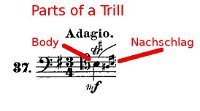 Open full-size figure
0:58Accidentals in Trills
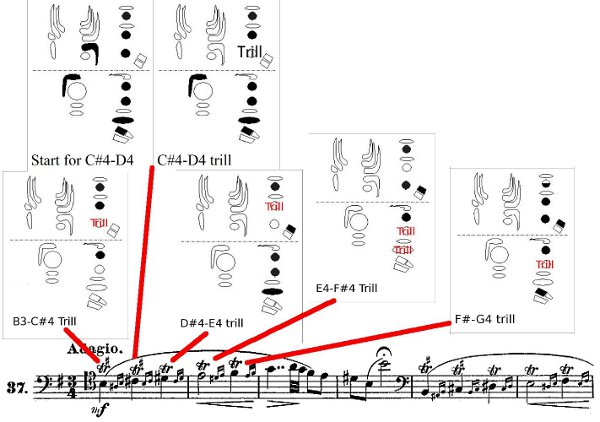
Notice that when an accidental is given above the trill, you need to add that accidental. For instance, the first trill is from B3 to C#4. The sharp over the trill indicates this.
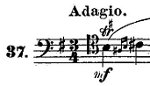 Open full-size figure
1:13Practicing the Trill Body
Practice each component of the trill separately first. Focus on fluid finger movements and correct timing. Make certain to accurately meet the next beat. Let me practice now with a metronome. I will have eighth notes indicated with the metronome.
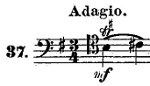 Open full-size figure
1:29Practicing the Nachschlag
Next I practice the nachschlag. Notice that the nachschlag takes place during one fourth of the note. Here it is written out:
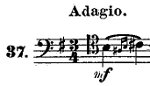 Open full-size figure
2:03Combining the Trill Body and Nachschlag
Now I practice with the two put together. You might want to first practice by stopping the body of the trill on the middle of the beat and then playing the nachschlag.
2:27Section
Then you can practice the full trill with the nachschlag.
2:41Applying the Trill Practice Method
Use this method practice for all of the trills in this study. Then go on to musically shape the trills. Vary your metronome setting as appropriate. You will find that this practice method also helps with the Mozart Bassoon Concerto and other bassoon repertoire.
3:03First-Line Trill Fingerings
Here are the fingerings for the trills in the first line.
 Open full-size figure
3:33Line 4 Trills and Turn Fingerings
In line 4 the C4 to D4 trill fingerings are the standard fingerings. The E4-F#4 has been given above. I use the alternate, left hand A4 fingering for the turn. Here are the fingerings for G4, A4, (G4 repeated), and F#4.
 Open full-size figure
4:02Fingering Order for the Turn
In this figure the red lines indicate the order of the fingerings moving from left to right. The blue lines show the position of the first and last fingerings for the turn.
4:30Trills in Lines 7 and 9
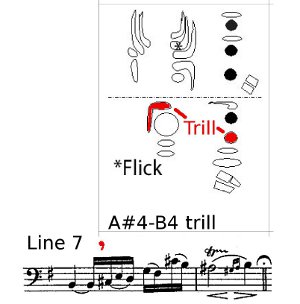
Here are the fingerings for the trills in lines 7 and 9.
 Open full-size figure
 Open full-size figure
4:47Lightly Tonguing the Low B
I choose to lightly tongue the low B in line 2, measure 2 at the fermata. I tongue the corner of the reed not directly in the center. This still provides the sound of a slur but aids with the start of the low note.
4:59Rhythms in Lines 8 and 9
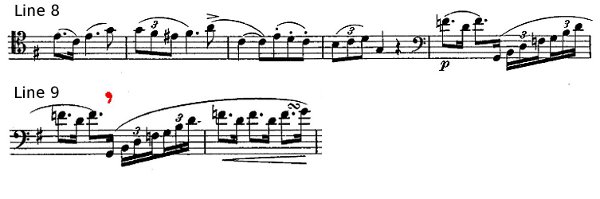
The rhythms in lines 8 and 9 are difficult. Practice carefully with a metronome to master the transitions between the 4 and 6 divisions of the beat.
 Open full-size figure
5:11Merry-Go-Round Rhythm Practice
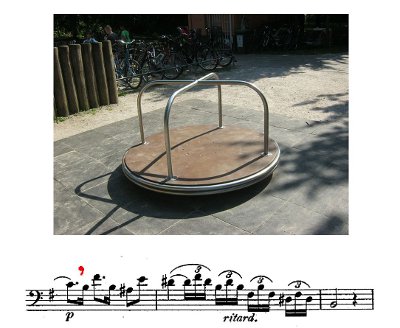
Line 10, measure 2 reminds me of getting on a merry-go-round as a child. Have you had that experience? When the merry-go-round is moving you need to run to get up to speed to hop on to it. In the same way you need to have the divisions of 6, the triplet 16ths going in your mind to "hop" on to the second beat.
 Open full-size figure
Merry-Go-Round Rhythm Practice, continued
------------------------------------------------------------------------ # REFLECTION
5:39Reflection: Continuation from Study #36
This is a continuation of my reflection in Weissenborn study number 36.
5:47Bela Siki and a Change in Musicality
A week or so after camp was over I went back to study piano lessons with Bela Siki. Before I had played more than about two or three phrases he stopped me and said, "Something has changed. Your touch is much more sensitive." I was too shy and embarrassed to explain the transformation that occurred in my life. In fact I was still trying to process just what was happening. It hadn't occurred to me that my musicality would be changed as well.
6:27God Working in Every Aspect of Life
Now I understand that God wants to touch and improve every aspect of my life. I began to realize that God was working in my inner self and anything that came out of it--thoughts, language, music, actions--would be impacted by those changes. Clearly I can't say that I somehow earned that change in my life. I wasn't devoted to a quest to find God and truth. It is more accurate to say that God sought me rather than I sought God. I was just going about living, trying to practice bassoon and piano, doing my school work, surviving adolescence, etc. But now when I look back on my life I realize that there were many times when I felt the presence of God or the pull of His spirit. Over and over again God was trying to get my attention and communicate with me. Please understand that I am not finished changing! The process that was begun on August 9th, 1973 was just the start. There is a lot of work yet to be done with me. I fail every day to live up to my full potential. However, I am also at peace knowing that God is working with me, in me, and through me. I suspect that if you are honest you will also acknowledge that you have felt the pull of God at times in your life. He has the peace, fulfillment, and happiness you have been searching for. I had a young friend who told me about Jesus and God. Let me be your friend and tell you as well. For further information please see this website. God bless you. http://www.2reed.net/choice/ ------------------------------------------------------------------------
Credits
- author Terry B. Ewell
- composer Julius Weissenborn