Sixth Bassoon Lesson, Part 1
Use of flick or speaker keys. Upward and downward slurs of
Comments
Use of flick or speaker keys. Upward and downward slurs of an octave. By Terry B. Ewell. BDP#193. www.2reed.net/bdp.
The original transcript is available here.
Videos
Captions are unavailable. The complete transcript follows.
Chapters
Transcript
0:00Intro Music: Home Sweet Home
Intro Music: "Home Sweet Home" from A Tune a Day, lesson 29 number 6.
0:14Introduction
Hello, I am Terry Ewell. I welcome you to this continuation of the series on beginning bassoon lessons. I started the series in 2008 (See BDP 25-27; 30-37). This series is based upon an article that I wrote in the year 2000. Teaching the Beginning Bassoonist
0:29Section
I am sorry it has taken me so long to get back to the series. You have probably noticed that I have been busy making a number of other videos.
0:39Flicking and Why It Matters
So, let's get started! The art of "flicking" is one of the most difficult things for young bassoonists to do. Given the difficulty, I think that it is important the students understand the reason for doing this. I always take the approach that Norman Herzberg did when he introduced flicking to me. I am going to give this to you now.
1:05Purpose of the Flick Keys
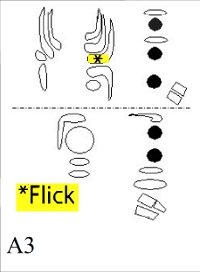
The purpose of the flick keys, or speaker keys, can be demonstrated on the pitch A3 above open F. Demonstration of tonguing A3 without the flick key down or a half hole.
1:22Section
You will notice that the start of each note is not very good. Sometimes there is a little extra "kk" or extra noise that is part of that. However, if I hold down the A speaker, the A flick key, that will be cleaned up. Demonstration of tonguing A3 with the flick key down.
 Open full-size figure
1:35Section
Every note is quite solid now and plays well.
1:47Notes Improved by Flicking
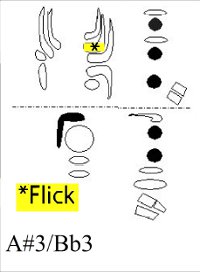
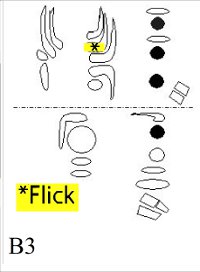
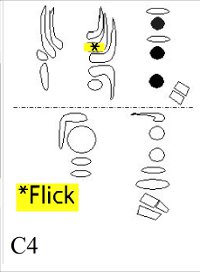
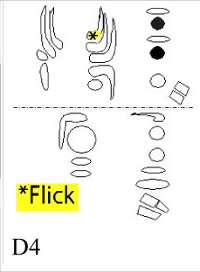
There are several other notes that can be improved with flicking. Although I introduce the notes in later lessons, let's go ahead and group them altogether now. So we introduce Bb3, B3, C4, and occasionally I flick D4.
 Open full-size figure
 Open full-size figure
 Open full-size figure
 Open full-size figure
2:04Section
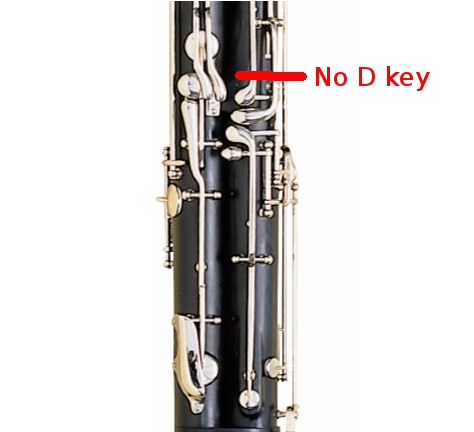
Please note that some of the student instruments do not have a D key.
 Open full-size figure
2:17Pitch Numbering and Octave Designations
I mention here that I use a numbering system or octave designations for the pitches that is developed by the Acoustical Society of America. This system is now standard throughout America and in many American universities. Pitch Numbering and Octave Designations
2:39How to Flick
Although some bassoonists (mainly in Europe) hold down the speaker or flick keys for the full duration of the note, I like many other Americans release the keys once the note starts. Thus we give the word "flicking" for it because we depress and release the key. The key must be down, however, at the start of the note.
3:00Two Situations Requiring Flick Keys
There are two situations that require the flick keys. The first is when you articulation one of the notes that needs to be flicked.
3:14Rubank Lesson 6, Number 3
Rubank lesson 6, number 3 provides an example of this. Example: Rubank lesson 6, number 3.
 Open full-size figure
3:44Flicking During Slurs
The second instance when we need to use the flick key is when we slur to one of those special notes with the interval of a third or more.
4:02Octave Slurs and Rhythmic Flicking
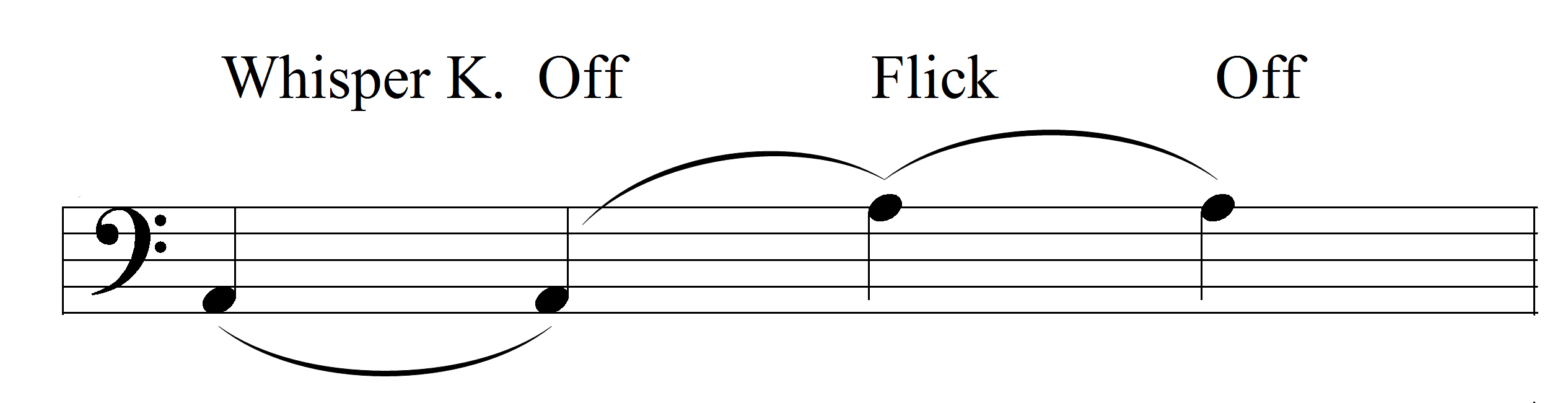
The exercise in Lesson 6 number 6 from A Tune A Day helps students to master the flicking technique during octave skips. So let's break this apart in two ways. First let's practice the release of the whisper key on the beat, the flick of the octave on the beat, and the release on the beat. Let me demonstrate first how this is done on the A octave. Example: A2-A3.
 Open full-size figure
4:43A Tune a Day Exercise
This is an easy way to first learn how to do that. So let me play number 6 for you now. Example: A Tune A Day, Lesson 15, number 6, with rhythmic flicking.
 Open full-size figure
5:30Using the D Key for C4
Now you may have noticed that I used the D key for to flick for C4. Normally you use the C key, but I do find in certain occasions that using the D key raises the pitch of C4 slightly. That is a flat note on my instrument. So I find that helps to bring up the pitch.
5:57Faster Flicking
Now let's do the exercise again but this time I will flick more rapidly. Example: A Tune A Day, Lesson 15, number 6, with more rapid flicking.
6:40Downward Octave Slurs
The down slur portion is in many ways just as difficult if not more difficult than the upward slurs of an octave. The way to effectively slur downward is to keep the embouchure---the lower jaw forward---so that the teeth are parallel. As you slur down you will need to move the jaw slightly downward and perhaps even forward. Getting the "hang of that" is not easy. Also I find that in the last slur from G3 to G2 it is helpful to open the first finger here and put it down. Open it all the way for G3 and put it down for G2.
7:32Closing Comments
Well, using the flick keys is really going to help the clarity of your notes. Careful work on this will greatly help your bassoon playing.
7:59Section
Closing Music: "Home Sweet Home" from A Tune a Day, lesson 29 number 6.
Resources
References
- Reference: Terry B. Ewell, “Teaching the Beginning Bassoonist,” The Double Reed 23/2 (2000): 35–43.here
Credits
- author Terry B. Ewell