Mozart's Bassoon Concerto, 1
Introduction and Editions
Comments
This video provides an introduction to the most famous bassoon concerto and which editions to use for studying and performing. By Terry B. Ewell, Bassoon Digital Professor. Assisted by Vincent Igusa, bassoon and Catherine Renggli, piano. www.2reed.net.
The original transcript is available here.
Videos
Chapters
Transcript with Time Codes
00:00Introduction
00:00 Music: Vincent Igusa, bassoon, and Catherine Renggli, piano. Towson University Recital Hall, 20 June 2017. Welcome, I am Terry Ewell, the Bassoon Digital Professor. I am quite excited to bring this new series to you about the Mozart Bassoon Concerto. The first movement of the Mozart Bassoon Concerto is perhaps the most significant work in the repertoire for bassoonists. I have performed the Concerto many times, including with the Hong Kong Philharmonic under the direction of Maestro Jah Jah Ling. The first movement of the Concerto is required for many university auditions. It is a staple of orchestral auditions as well. Last of all, the accessibility and beauty of the Concerto has made it a favorite with performers and audiences for many years. Thus, given the significance of the work, you should carefully research all features of the Concerto. My goal with these videos is to educate you about neglected and perhaps even unknown aspects of this prized possession in our repertoire.
01:34Editions
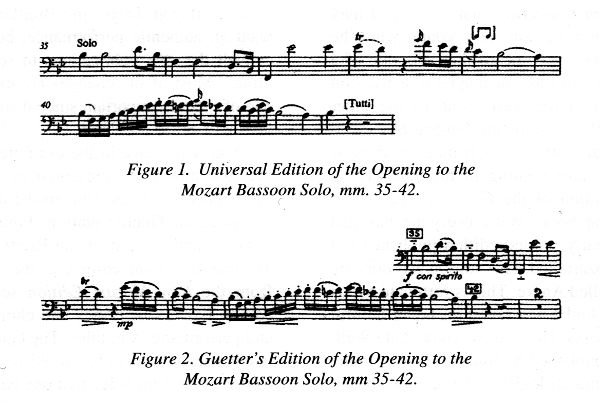
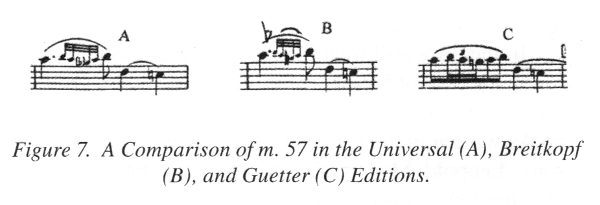
There are numerous editions of the Mozart Concerto available. I own seven print editions of the work. You might be thinking, are the editions really all that different? Well, let’s take a look. I have performed from the edition in Figure 1 for several decades. The version in Figure 2 was perhaps the most common edition of the Concerto in twentieth-century USA. Notice the striking differences between the two versions. Guetter has added dynamics, crescendos and decrescendos, articulations, and even con spirito. None of these appear in the version penned by Mozart. In Figure 1, Universal Edition, additions made by the editor are presented in parenthesis or with dashed lines. This allows the performer to accept or reject the editor’s suggestions. Let’s make another comparison in the Concerto. Thus, you can see that your choice of music will determine the manner in which you play and even the particular notes you perform in the concerto. The Guetter edition writes out the turn, and it appears quite different than the other versions. The turns in Examples B and C give B natural. These sound "correct" because of the many performances of the work you may have heard. However, the turn with B-flat would have been quite common for the performance practice in Mozart’s time. The editor in version A, the Universal Edition, indicates this. Only by referring to the Universal Edition or another edition more closely aligned with the original version would you know about playing a B-flat here. Music: Performance of mm. 50–57 There are many more differences between the editions, and you should consider them carefully. These are my recommendations for performance editions: Concerto in Bb Major K191 (Turkovic) – BSN/PN Composer: Mozart, Wolfgang Amadeus Publisher: Universal Edition (Austria) Edition: 18123 Concerto in Bb Major K191 (Urtext) (Study Score) – BSN/ORCH Composer: Mozart, Wolfgang Amadeus Publisher: Bärenreiter (Germany) Edition: TP253 Concerto in Bb Major K191 (Urtext) – BSN/PN Composer: Mozart, Wolfgang Amadeus Publisher: Bärenreiter (Germany) Edition: 4868-90 Concerto in Bb Major K191 (Score & Set) – BSN/ORCH Composer: Mozart, Wolfgang Amadeus Publisher: Breitkopf & Härtel (Germany) Edition: 15103set
 Open full-size figure
 Open full-size figure
04:23Errors in Editions
Not all of the editions above are without errors. For instance, the second movement of the Universal Edition of the bassoon part has missing rests in measures 1 and 2. In all cases, I suggest you check your version of the music with the free, authoritative edition of the work. Log onto the NMA Publications website and type in 191 in the appropriate box. 191 is the KV number for the Bassoon Concerto. NMA Publications There is no excuse, there is no excuse, there is no excuse for any bassoonist to be playing the Concerto without knowledge of the best edition of the work. This edition is available without charge to anyone with access to the Internet.
05:17Recommended Articles
Here are three articles that will further guide your study of the concerto: Ewell, Terry B. John Miller's Master Class on the Mozart Bassoon Concerto K191. The Double Reed 28/1 (Winter 2005): 63–68. John Miller's Master Class on the Mozart Bassoon Concerto K191 Ewell, Terry B. Playing those "Missing" Notes in Baroque and Classical Concerti. The Double Reed 20/1 (1997). Playing those "Missing" Notes in Baroque and Classical Concerti Ross, David J. "Ornamentation in the Bassoon Music of Vivaldi and Mozart," Part II. The Double Reed 9/3 (Winter 1986). I am very grateful for the assistance of my student Vincent Igusa and pianist Catherine Renggli, who perform this composition for the videos in this series. Last year, Vincent performed the first movement of the Concerto with the Baltimore Symphony Orchestra. He was a sophomore in high school at the time. It is my hope that this series will awaken in you a new appreciation for the Concerto and enlighten your understanding of this wonderful composition. Music: Vincent Igusa, bassoon, and Catherine Renggli, piano. Towson University Recital Hall, 20 June 2017.
Resources
References
Credits
- author Terry B. Ewell
- bassoon Vincent Igusa
- piano Catherine Renggli
- Artwork and Graphics by Terry B. Ewell
- Copyright 2015-22 by Terry B. Ewell.
- Copyright (c) 2018 by Terry B. Ewell. All rights reserved.