Mozart's Bassoon Concerto, 10
Discussion of the Second Movement
Comments
Discussion of performance details in the Second Movement. By Terry B. Ewell, Bassoon Digital Professor. BDP #221. With Elaine Ross, piano. www.2reed.net.
The original transcript is available here.
Videos
Chapters
Transcript with Time Codes
00:00Introduction
Music: "Mozart Mashup" with Terry Ewell and Elaine Ross Often the second movement of the Mozart Bassoon Concerto is performed in a slow, Romantic style. Making use of the tactus, however, illuminates a very different essence for the movement. Not only does using this tactus provide a tempo unity to the entire Concerto, but there are also aspects of the movement that are improved and clarified with this tempo.
00:43Tempo Relationship
Let me first explain the tempo that I arrived at for the second movement. I relax the tempo slightly from the tactus of 92 to a tempo of 88 for the eighth note. Thus, the relationship between the speed of the quarter note in the first movement and the speed of the quarter note in the second movement is close to two to one.
01:18Italian Vocal Style
The metronome marking of 88 to the eighth note, or more appropriately 44 to the quarter note, is a faster tempo than most performances of the work. This faster tempo references Italian vocal compositions. We know from Mozart's biographical information, compositions, and documents from the time that Italian vocal traditions were quite influential on his music.
02:10Singing the Phrases
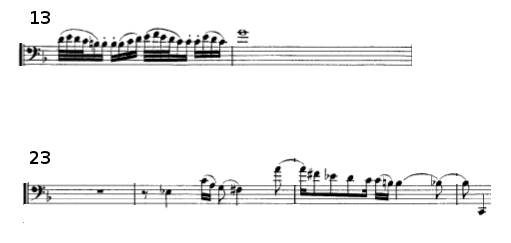
This quicker tempo encourages vocal gestures and phrasing. I encourage you to try singing phrases in the second movement, particularly the longer phrases such as those starting in measures 13 and 23. You will find that this quicker tempo allows for complete phrases without adding breaths by the voice in the middle of phrases. Of course, the bassoon can perform longer phrases, but it is important to recognize the influence of vocal limitations upon the writing of lyrical melodies.
 Open full-size figure
03:16Andante ma adagio
Mozart provides the tempo indication Andante ma adagio with a time signature of "C," or common time. This indicates that the pulse of the movement should be felt in quarter notes, which thus provide the relaxed "walking tempo." It is important to note that the pulse is not in eighth notes. This is a mistake that many performers make. If the pulse is felt in eighth notes, the tendency is to slow down the music considerably.
04:09Change in Orchestration
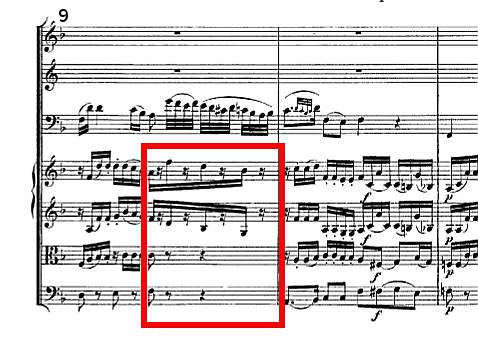
Of special interest is the change of orchestration in measure 9. For most of the introduction and the first part of the solo, the accompaniment has constant sixteenth notes. However, in measure 9 the sixteenth notes stop when the bassoon has the florid, cadenza-like passage with thirty-second notes. Notice how this allows for the bassoonist to vary the tempo slightly, much as an Italian vocalist would add rubato to a florid passage. You will hear in my performance that I take liberties with the tempo here.
 Open full-size figure
05:02Metrical Freedom
At slower tempos, this metrical freedom would be missed entirely and the Italian vocal character of the passage radically altered.
05:19Performance Edition
I have prepared a performance edition for the second movement of the Concerto that puts in print what I perform in the next video. Please understand that this is not a replacement for the Urtext edition contained in the Neue Mozart Ausgabe; rather, it is provided here to clearly present the performance choices that I make with the composition. The music can be found linked with the videos on Mozart Videos
05:55Pianissimo Recapitulation
Mozart gives few dynamics in the Second Movement. I like to perform the recapitulation, starting with the orchestra part in measure 27, at the pianissimo dynamic. This provides for a beautifully expressive moment in the work.
06:29Ornamenting the Sequence
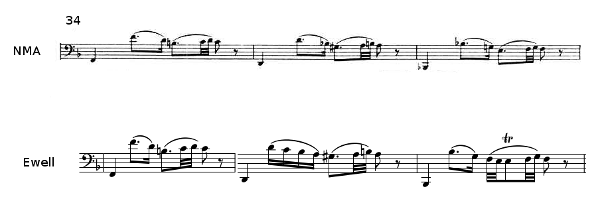
There are aspects to my performance of the second movement that depart from today's conventional performances. In Videos 4 and 5 in this series (BDP 215 and 216), I discussed adding ornamentation. In measures 34 through 36, I ornament the repetitions in the sequence. Above here we have the Neue Mozart Ausgabe, the Urtext edition, and below is my performance edition. You can see in this first iteration of this idea that there are no changes. In the second, I make changes on the second beat. In the third, I add a trill.
 Open full-size figure
07:36Florid Ending
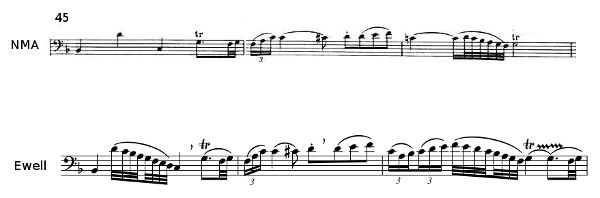
At the end of the final statement in the movement, I add a florid passage to provide closure. Notice that I also highlight the break between the two D4s in measure 46. These changes are again references to Italian vocal traditions.
 Open full-size figure
08:11Cadenza
The cadenza I perform in this movement is one that I composed as an undergraduate student at the University of Washington. You will find that cadenza in print at cadenzas
08:29Modern Performance Choices
There are other choices that I make in my performances that are partly for my convenience and partly to best present the movement. I perform on a modern bassoon. I don't have time to master a bassoon and reed from the Classical period. I am also using vibrato, which is a twentieth-century addition to woodwind performance. I will discuss vibrato in more detail in a later video in this series.
09:30Next Video
Please now proceed to the next video for a full performance of the second movement.
09:39Closing Performance
Music: "Mozart Mashup" with Terry Ewell and Elaine Ross.
Resources
References
Credits
- author Terry B. Ewell
- piano Elaine Ross
- Artwork and Graphics by Terry B. Ewell
- Copyright 2015-22 by Terry B. Ewell.
- Copyright (c) 2018 by Terry B. Ewell. All rights reserved.