Mozart's Bassoon Concerto, 12
Comments on the Third Movement
Comments
This video provides a discussion of tempo and other performance issues in the third movement. By Terry B. Ewell, Bassoon Digital Professor. Assisted by Vincent Igusa, bassoon and Catherine Renggli, piano. www.2reed.net.
The original transcript is available here.
Videos
Chapters
Transcript with Time Codes
00:00Introduction
Music: "Mozart Mashup" with Terry Ewell and Elaine Ross. Hello, this is Terry Ewell, and you are viewing the twelfth video in the series on the Mozart Bassoon Concerto.
00:17Tempo di Menuetto
The tempo of the third movement of the Mozart Bassoon Concerto, which is marked Tempo di Menuetto, best fits in the category of Mozart's "moderate minuets." There is an interesting note at the bottom of page 338 of Sandra Rosenblum's Performance Practice in Classic Piano Music:
00:43Rosenblum and Tomášek
"An outstanding example of the moderate minuet occurs in the finale of the first act of Mozart's Don Giovanni, for which there exists a metronomization of quarter note equals 96 suggested by Wenzel Tomášek."
01:01A Tempo of 96
This is exactly the tempo that I have chosen for the third movement, which is just slightly faster than the tactus of 92. (The concept of the tactus was presented earlier in the series, so please see Video 9, BDP #220.) It is common for the last movements of concertos to be faster in tempo than the preceding movements. Even so, at the tempo of 96 to the quarter note, this is quite slower than most contemporary performances. Many performers take this movement faster than a tempo of 96, and as a result the gentle dancing quality is missed.
02:10Einleiten
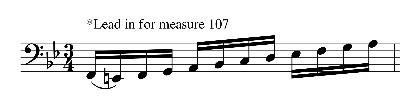
Every time a fermata is given in the Mozart Bassoon Concerto, it calls for added notes, whether with a cadenza or an Einleiten. A simple lead-in, or Einleiten, best fits the fermata in measure 106. Performance, mm. 105–107
 Open full-size figure
02:50Ornamentation
The lead-in, however, is not the only instance in the movement where I add notes. All of the changes may seem outlandish to you, and indeed they certainly depart from contemporary performances of the work. However, my changes are carefully considered and have come from decades of study of the work, one that is deeply loved by many of us. If you have not yet viewed the fourth video in this series, BDP #215, please review my reasoning for adding ornamentation to the Concerto.
03:50Ornamented Repeats
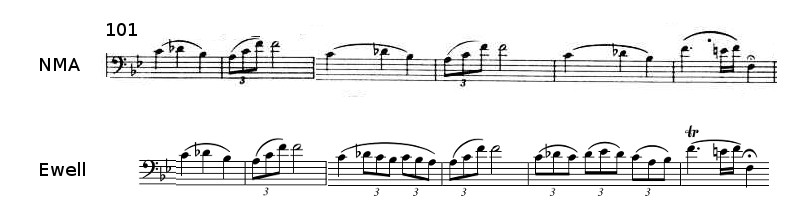
The most significant changes that I make are with ornaments to repeated music and flourishes at the ends of important sections. First, consider the repeated passage in measures 101–105. At the top, the Neue Mozart Ausgabe, the authoritative edition, is supplied. At the bottom is my ornamented version. The first instance of the figure is without ornaments. However, the second and third repetitions are changed significantly. Performance, mm. 101–107
 Open full-size figure
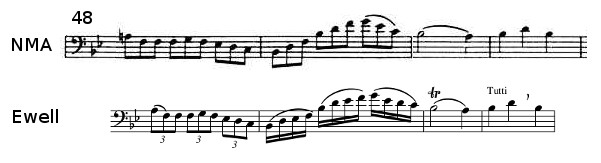
05:00Flourishes Before Trills
I provide flourishes before trills at the end of the first and last A sections in this Rondo form. Here is the first example: Performance, mm. 48–52
 Open full-size figure
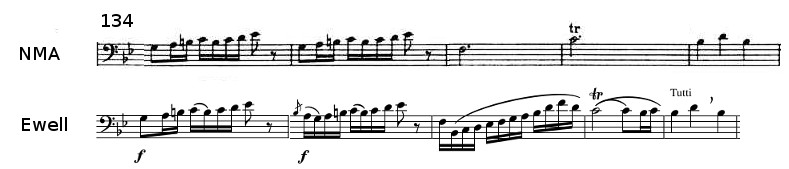
05:22Final Flourish
Here is the second example, which ends the solo part. Performance, mm. 134–138
 Open full-size figure
05:39A Living Piece of Music
In my view, the Concerto should be a living piece of music. In a sense it should be reinvented with each performance; it must be breathed to life with each expression of the work. There is not one perfect performance of the work by any single bassoonist. If that were the case, then we should just capture that one performance, whether in audio, video, or virtual media of some sort, and then only refer to that forevermore.
06:37Many Interpretations
Rather, there should be hundreds of expressions of the Concerto, each one of which leads us to new understandings and insights. Each performance adding to the rainbow of light emerging from the prism of the composition.
07:03Performance Edition
I have prepared a performance edition for the third movement of the Concerto that puts in print what I perform in the next video. Please understand that this is not a replacement for the Urtext edition contained in the Neue Mozart Ausgabe, rather, it is provided here to clearly present the performance choices that I make with the composition. The music can be found linked with the videos on Mozart Videos
07:46Performance Practice
This performance edition is not the "last word" for my ideas on the Concerto, nor should it be for yours. In fact, if I were to perform the work again, there would be many new ideas to explore.
08:20Tutti and Solo
In the performance edition I have prepared, you will see the words Tutti and Solo. The tutti sections are the portions where the bassoon joins with the other instruments. Here the bassoon is in a supporting role, and for this reason I seek to blend with the other instruments. When the solo part is given, however, then I play out, with greater volume and a soloistic tone.
09:00Closing Comments
Please now enjoy listening to the third movement in the next video.
09:09Closing Performance
Music: "Mozart Mashup" with Terry Ewell and Elaine Ross.
Resources
References
- Mozart Videoshere
Credits
- author Terry B. Ewell
- bassoon Vincent Igusa
- piano Catherine Renggli
- Artwork and Graphics by Terry B. Ewell
- Copyright 2015-22 by Terry B. Ewell.
- Copyright (c) 2018 by Terry B. Ewell. All rights reserved.