Weissenborn Study #21, Part A
Weissenborn Opus 8/2, Study #21 for advanced bassoon students. Strategies for rhythmic precision, fingerings for trills, mordents.
Comments
Weissenborn Opus 8/2, Study #21 for advanced bassoon students. Strategies for rhythmic precision, fingerings for trills, mordents. By Terry B. Ewell, Bassoon Digital Professor. BDP #129a
The original transcript is available here.
Videos
Captions are unavailable. The complete transcript follows.
Chapters
Transcript
0:19Introduction and Eighth-Note Subdivisions
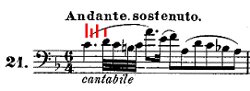
Welcome to Weissenborn Study #21. I am Terry Ewell. This is a very challenging study in many aspects. Rhythmically, the study is difficult for students to perform. Take, for instance, the first measure. This is best mastered with eighth-note subdivisions. You must subdivide the dotted quarter note in order to perform it accurately.
 Open full-size figure
0:50Marking Beats and Subdivisions
Notice how I arrange my marks for eighth notes. The longer marks indicate the beats and the shorter marks indicate the middle of the beats. I find that this helps me better keep track of the rhythm.
1:08Subdividing the Turn in Measure 3
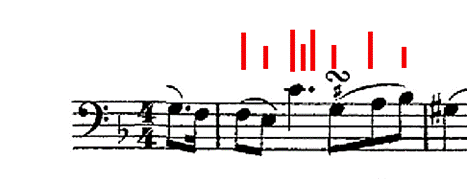
The turn in measure 3 of the first line is another place that needs to be subdivided. I will first tongue eighth notes and then play it as written.
 Open full-size figure
1:43Written-Out Thirty-Second Notes
Be sure to study the written-out thirty-second notes Weissenborn has supplied with measure 3.
1:50Turns in Line 2
Weissenborn does not provide written notation for the turns in line 2, the last measure. I play this as a sixteenth note, triplet thirty-second notes, and two sixteenth notes.
 Open full-size figure
2:10Rhythmic Accuracy in Line 6
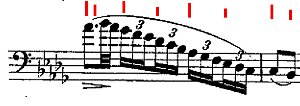
One of the other difficult measures for correct rhythmic performance is found in line 6, the first measure. The eighth-note subdivisions again help with accuracy.
 Open full-size figure
2:43Cantabile, Con Espressione, and Musical Motion
Once the notes are mastered, however, there is still more practice to be done. Weissenborn marks the beginning cantabile and the recapitulation con espressione. Thus, the music needs to be sung and performed with expression. This is best done by feeling quarter-note beats and moving the music forward toward musical goals, then relaxing the music after those goals are reached. Please consider my discussion in Bassoon Digital Professor #100 about how motion is made in music.
3:23Shaping a Long Trill
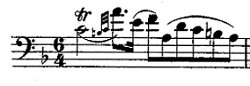
I will be discussing more completely how to practice trills in Study #37. However, here in line 2, measure 1, consider how to create a long trill that is musically shaped by increasing in speed. Don't play it in a totally metronomic fashion like this.
 Open full-size figure
3:51Section
Instead, practice shaping the trill in different ways.
Open full-size figure
4:15Alternate Fingerings for G-flat 2 and A-flat 2
Last of all, I use the alternate fingerings for G♭2 and A♭2 in line 6. In the music I mark alternate fingerings with an upside-down A.
4:33Trill and Mordent Fingerings
Let's look at some of the fingerings for trills and mordents in this study. For the first trill in line 2, measure 1, we use the normal fingerings. Start C4 with the flick key and then trill between C and D. In line 2 we have the first occurrence of mordents in the Weissenborn studies. The fingerings for these mordents are also the standard fingerings. So, for E4 to F4 use your standard E-to-F fingering, and for C4 to D4 use your standard C-to-D fingerings.
5:24Understanding the Mordent
However, let's discuss the mordent a little bit. In the Baroque period and the contemporary use of the German term mordent has a downward motion. You can observe this in the German editions of the Weissenborn Bassoon School. However, in the English language the term mordent means an upward motion. The Germans call this a short trill or a pralltriller. This can be confusing for English speakers because mordent in English is an upward motion whereas in the Baroque period and contemporary German usage it is downward. Mordents are played at differing speeds. You can see in the upper example there are triplet sixteenth notes and in the lower example there are even faster notes.
6:31B-flat 3 to C4 Trill
In line 3, measure 1, the trill here is from B♭3 to C4. This is a trill that needs to be made by moving the ring finger of the left hand.
6:52C to D-flat Trill Choices
In line 6, measure 3, we have a trill from C to D♭. You have two choices here. The one I favor is trilling the D key and the C♯ key. This, however, can be a little more awkward. The second choice is to use the C♯ trill key that is on the instrument. This is, of course, a very easy trill to execute. However, I find the interval, the distance between C4 and D♭4, to be a little too narrow. For that reason I choose the first alternative.
Credits
- author Terry B. Ewell
- composer Julius Weissenborn