Weissenborn Study #30
Weissenborn Opus 8/2, Study #30 for advanced bassoon students. Discussion of the separation of tone production components for articulation lengths 1-5. The third discussion on tuning (bassoon registers).
Comments
Weissenborn Opus 8/2, Study #30 for advanced bassoon students. Discussion of the separation of tone production components for articulation lengths 1-5. The third discussion on tuning (bassoon registers). By Terry B. Ewell, Bassoon Digital Professor. BDP #138.
The original transcript is available here.
Videos
Captions are unavailable. The complete transcript follows.
Chapters
Transcript
0:16Tango Character in Study #30
Welcome, this is Terry Ewell. I think if Weissenborn had ever heard a tango, he would have written something like this: Example Tango
0:26Section
I can't help but hear a Tango when I play certain portions of this study! Sorry, I now think you will be imagining the same thing too.
0:52Rhythmic Accuracy in Lines 3 and 4
There is a tendency to rush during the staccato eighth notes in line 3. Unfortunately I amply demonstrated this rushing in my recording of the study! Example (picture only)
1:06Three Slurred Notes
Another rhythmic problem in the study is found with the three slurred notes. The tendency is to rush those as well. Don't play them like this:
 Open full-size figure
Three Slurred Notes, continued
(Example line 4 rushed.)
1:26Alternate Eb4 Fingering and the D4-Eb4 Trill
Instead keep an accurate rhythm. (Example line 4 accurate.) In line 4 you can play Eb4 with just the G key. You might find this easier, and certainly it makes for a better D4-Eb4 trill.
1:52Playing Descending Thirds on the Wind
Now let's work some more on our control of the air and tongue. Let's first slur all the notes in the descending 3rds in line 3. Pay close attention to the way in which you phrase the notes. Create a full phrase with these notes. Shape the notes with your air, "the wind." Example slurred
 Open full-size figure
2:22Articulation Lengths 1-5
Now without changing the beautiful shape you made with the air let's make different lengths of articulation. In Weissenborn study #7 I introduced a scaling of articulations from 1 to 5.
2:41Section
We will practice with those same articulations here. Here is length number 5. Example
2:51Separating Breath, Embouchure, and Tongue
Notice that component 1 (breath) and component 5 (embouchure) work just as they did when I slurred the example. The length of notes is determined by the amount of time the tongue (component 4) is on the reed, not by a change in the other components. For length number 5 the tongue touches the reed as little as possible.
3:25Section
Here is length number 4. Example
3:40Section
Here is length number 3. Example Here is length number 2. Example And here are the shortest notes, length number 1. Example
4:00Comparing Articulation Lengths with Reaper
I realize that it may be difficult for you to hear the differences, so let's take a look at the sound waves. Here I am using a software program called Reaper.
4:20Section
Let's see how well I did differentiating the note lengths. You can see a difference between lengths 5 and 4. The difference between 3 and 4 is more difficult to see partly because I didn't play the two at the same speed. It looks like the later notes are indeed shorter in 3 than in 4. The differences in note lengths between 2 and 3 and 1 and 2 are distinct.
 Open full-size figure
 Open full-size figure
 Open full-size figure
 Open full-size figure
4:49Independent Tone-Production Components
Only by separating the five components from one another and allowing them to operate independently can I achieve this variety of articulation. If my embouchure or the jaw tries to articulate, it will only impede the variety I can achieve with the tongue at a variety of tempos.
5:13Section
Practice with all five articulations and see if you can gain further mastery. In the actual study I would choose to play the short notes at a number 2 or 3 in length.
5:28Jaw Movement and Articulation
I realize in my performance of the study I do move my jaw with the articulations in that passage. Jaw movements do allow for some shaping of the staccato notes.
5:54Section
However, my experience is that jaw movement when coordinated with tonguing is limited to the middle range of articulation numbers. It works with articulation numbers 2 or 3, but will not work well with articulations 5, 4, and 1. My point is that for the greatest variety of articulations you need to minimize or remove entirely the motion of the jaw or embouchure. ------------------------------------------------------------------------ # REFLECTION
6:19Reflection: Third Discussion on Intonation
This is the third part of our discussion of intonation on the bassoon. In this reflection I draw upon material I presented in an article published in the Double Reed journal: "Teaching the Beginning Bassoonist", The Double Reed 23/2 (2000): 35-43. http://www.2reed.net/EwellArticles/BeginningBassoonist_DR23_2.pdf
 Open full-size figure
6:37The Three Bassoon Registers
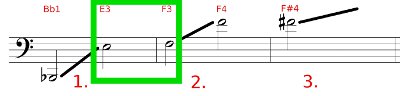
There are three registers on the bassoon.
6:44Pitch Tendencies within the Registers
In general there is a progression from sharper notes at the bottom of the registers to more neutral notes in the middle and then towards flatter notes at the top of the registers. The second register's progressions through the vowels are more rapid than the first register. The pitches tendencies are rather wild and uneven in the third register.
7:07Vowel Shifts across Register Breaks
Moving between registers requires a rapid vowel shift. For instance, movement from E3 to F3 requires a quick shift from "ee" to "ah" to properly tune the notes.
7:24Practicing Scales and Arpeggios with Drones
Carefully experiment with other aspects of these registers. Mastering intonation on the bassoon requires that you understand these pitch tendencies on the instrument. Practicing scales and arpeggios with drones is a great way to gain mastery with intonation. http://www.2reed.net/2_drones.html
7:47Further Study of Register Breaks
I will be explaining more about tuning and crossing over a register break in Weissenborn study #32. ## Note on F3 Acoustically F3 is the top note of the fundamental range of the bassoon, the upper most note of the first register. However, F3 is quite sharp on Heckel bassoons, and for this reason I am grouping it with the second register. It requires a vowel type closer to F#3 than E3. Your bassoon may be different.
Credits
- author Terry B. Ewell
- composer Julius Weissenborn