Weissenborn Study #35, Part B
Weissenborn Opus 8/2, Study #35B for advanced bassoon
Comments
Weissenborn Opus 8/2, Study #35B for advanced bassoon students. Using vibrato for phrasing. Ways to practice vibrato. Performance of study #35. By Terry B. Ewell, Bassoon Digital Professor. BDP #143B.
The original transcript is available here.
Videos
Captions are unavailable. The complete transcript follows.
Chapters
Transcript
0:00Reflection: Drawbacks of Throat Vibrato
There are drawbacks to a throat vibrato. Sometimes it can result in a "nanny goat" vibrato that is too fast. In other individuals the vibrato can be choked off at each pulse. In both cases it is important to support properly the tone and view the vibrato as coloration or gentle massaging of the tone. In all cases, seek to relax the throat area and allow free movement.
0:33Throat Vibrato and Independence
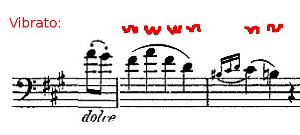
Using the throat for the vibrato allows for vibrato to be independent of fingering and pitch control. However, I many times find students restarting the vibrato with each note change. Take, for instance, the pickup to line 7 in Weissenborn Study #35. Often it is played like this:
0:55Vibrato Restarting with Each Note
Example with vibrato restarting
 Open full-size figure
1:07Section
There are times at which I will restart my vibrato like that.
1:12Section
However, that is a coloration of the notes rather than an expression of music motion or phrasing. I prefer to be able to do both. Many of my students, however, at first can only turn on the vibrato with the start of each note.
1:28Practicing a Phrase on a Monotone
Let's practice the musical phrase---a drive---with dynamics and vibrato, on a monotone. Playing on a single tone is a great practice method for musical gestures. This really helps you to isolate musical phrasing, dynamics, and vibrato. I will set the metronome so that you can hear the beats.
1:53Section
Example Play on single note
2:15Shaping Notes toward the Downbeat
Did you hear that I am shaping the notes, driving the notes to the downbeat of the second measure?
2:23Repeating the Single-Note Exercise
Here it is again. Example single note.
2:43Continuous Dynamics and Vibrato
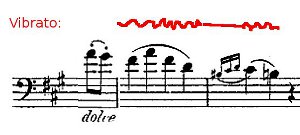
Did you notice that I am varying both the dynamics and my vibrato? Both are creating a continuous arc or rainbow of sound that is not chopped up.
2:53Playing the Phrase as Written
Now let's hear that as written, but retaining the same phrase shape.
3:01Section
Example as written
 Open full-size figure
3:27Vibrato Phrasing in Weissenborn Study #33
Just a few studies ago Weissenborn provided us with another example for practicing vibrato. Take a look at the opening of study #33.
3:35Section
For instance, I start with two, 2-bar gestures followed by a much longer phrase. Notice that I use changes in the dynamics and vibrato to emphasize the phrase shaping.
3:51Section
Example from video
4:40Practicing Vibrato Speed
You can practice mastery of your vibrato by varying the speed. Set the metronome to 60 and try varying the number of pulses per beat.
4:48Section
Play: 11 22 33 44 55 44 33 22 11
5:36Vibrato Speed and Dynamics
Most often people increase the speed of their vibratos in tandem with an increase in dynamics. This is what I did in the two examples earlier in this video. However, if you really want mastery of vibrato you need to vary the speed at any dynamic. You will know that you have gained independent control of components 1 and 2 when you can perform these exercises:
6:04Vibrato Exercises
These exercises continue in the video. ------------------------------------------------------------------------
Credits
- author Terry B. Ewell
- composer Julius Weissenborn