Weissenborn Study #40
Weissenborn Opus 8/2, Study #40 for advanced bassoon
Comments
Weissenborn Opus 8/2, Study #40 for advanced bassoon students. Three aspects to practice. The inner game. Guest performer Vincent Igusa. By Terry B. Ewell, Bassoon Digital Professor. BDP #148.
The original transcript is available here.
Videos
Captions are unavailable. The complete transcript follows.
Chapters
Transcript
0:15C# Major and Db Major
Welcome, this is Terry Ewell. Weissenborn gave the key of C# major for this study in his original collection of 60 studies. Perhaps the key signature was changed because there is no other study in Db major in the present collection of 50.
0:37Three Aspects of Study #40
There are three aspects of study #40 I want you to notice. We have dealt with all of these aspects in prior studies, so this will reinforce what you have already learned.
0:54Divisions of Three and Four
The transitions from divisions of three to four in the first line are made all the more difficult with the eighth note on the down beat. I suggest you practice this with a metronome in these ways. First tongue on a monotone the divisions of threes and fours.
1:35Tonguing the Printed Rhythm
Then tongue the rhythm as printed on a single tone. Now practice the passage as printed.
 Open full-size figure
2:05Balancing Slurred and Tongued Notes
Slurred notes often sound louder than tongued notes. If anything, you need to give more air to the tongued notes.
2:14Avoiding Accents on Slurred Notes
Don't play like this: (Example with accented slurred notes---2 measures Instead keep the dynamic even.)
2:27Keeping the Dynamic Even
Instead keep the dynamic even. (Example no accents --2 measures)
2:38Rhythms and Sprints in Line 6
In line 6, measure 2 the notes are difficult to perform. Put to use rhythms and sprints here. If you need to review these principles please look at the earlier videos in this series.
2:53Weissenborn's Rare Breath Mark
The breath indicated in the study by Weissenborn is rare! He gives only two breath marks in all of the studies and this is the first one. It indicates not only a place to breathe but also the start of new musical material. ------------------------------------------------------------------------ # REFLECTION
3:07Reflection: The Inner Game of Music
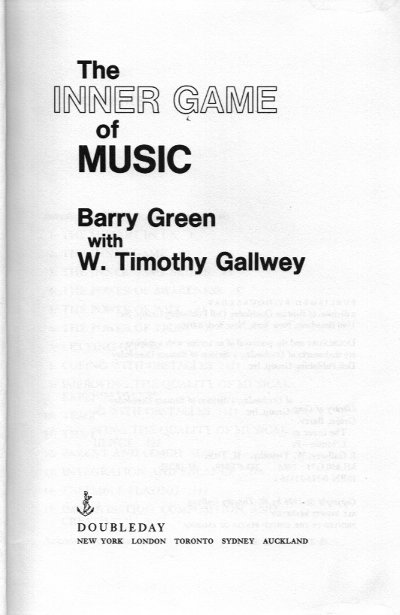
...there are a whole set of inner problems that we also face and which directly affect our outer performance...As we turn to examine the inner world, with its teeming doubts and hopes and expectations, we need to know just what is going on inside us. Barry Green, The Inner Game of Music (New York: Doubleday, 1986), pp. 11-12.
 Open full-size figure
3:34Music and the Inner Life
As a musician you are probably figuring out that music is more than just physical sound, it is something internal. Music moves our emotions and stirs our inner life. It is out of this inner life that musicians bring forth their music.
3:49The Inner Game and the Outer Game
Barry Green with co-author W. Timothy Gallwey both recognize that there is an important connection between the "inner game" and the "outer game." Timothy Gallwey in his well-known book The Inner Game of Tennis presents this relationship with practical approaches to tennis playing skills.
4:13Inner Life and Outer Life
Turmoil in your inner life will bring forth turmoil in your outer life. Peace in your inner life will bring forth peace in your outer life. Your inner life determines the course for many aspects of your existence.
Credits
- author Terry B. Ewell
- composer Julius Weissenborn