Weissenborn Study #43
Weissenborn Opus 8/2, Study #43 for advanced bassoon
Comments
YWeissenborn Opus 8/2, Study #43 for advanced bassoon students. Phrasing with varied articulations. Quotation from Beethoven's Heiligenstadt Testament. By Terry B. Ewell, Bassoon Digital Professor. BDP #151.
The original transcript is available here.
Videos
Captions are unavailable. The complete transcript follows.
Chapters
Transcript
0:19Weissenborn's Inspiration from Beethoven
Welcome, this is Terry Ewell. Many editions of this study miss the important note that Weissenborn gives to the student. The original text to this study explains Weissenborn's inspiration:
0:36Beethoven's Fourth Symphony
"Study based on the main motive of the 2nd movement of Beethoven's 4th Symphony. A rhythmical tongue and a sensitive ear are needed above all to play this well." (Universal Bassoon Edition #18122, Study #49)
0:51Beethoven Excerpt
Before we examine the study, let's first consider the excerpt.
 Open full-size figure
1:17Comparing Beethoven and Weissenborn
Line 7 of the study is not identical to the excerpt, but you can clearly see Weissenborn's imitation of that portion of the bassoon solo although not all of the notes sound the same.
 Open full-size figure
1:42Rhythm, Tempo, and a Sensitive Ear
This study is quite demanding for the reasons stated by Weissenborn. The student is required to keep the rhythm precise, the tempo steady, and to maintain a "sensitive ear."
1:56Phrase Shaping in Lines 9 and 10
Lines 9 and 10 provide an opportunity to practice phrase shaping during articulated notes and rests. Mastering the exercises I give to you below will really help you to gain control over your articulation.
 Open full-size figure
2:12Practicing Different Articulations
First let's practice the section with different articulations. Also use a metronome. I use the tempo 84 for the eighth note.
2:29First All Slurred
First all slurred.
2:38Shaping Phrases with the Air
I suggest practicing it slurred several times so you can really sense the phrasing you are making with your air. When you achieve a phrasing you like, you will need to keep this regardless of what the tongue does.
2:52Varying the 32nd-Note Articulation
The 32nd note is very relatively fast so I don't think I can distinguish five different articulations on that note. I should be able to make three different articulations, however: legato tonguing (5), medium (3), and staccatissimo (1). Just for our practice here I will keep the 16th note with legato tonguing and vary just the 32nd note. First I will do it on a single tone and then as written.
 Open full-size figure
3:29Examining the Sound Waves in Reaper
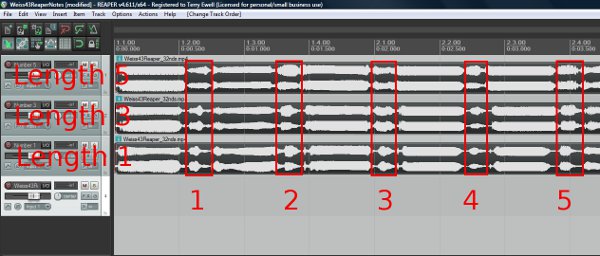
Voice over. Let's take a visual look at the sound waves I produced. I created a short audio clip from the video and then I have lined up the graphics of the sound waves in a software called "Reaper." The top channel is length 5, the next channel is length 3, and the last channel is length 1.
5:02Timing and Length of the 32nd Notes
Visual observation shows some inconsistencies with the length of the 32nds and especially the timing of the notes. Boxes number 1, 4, and 5 are pretty good. The notes show the correct lengths and generally start at the right time. Boxes 2 and 3, however, show timing problems especially with note length 5. I am also not quite as pleased with the note lengths.
5:34Keeping the Starts of Notes Consistent
Remember that the starts to each note should occur with the same timing. It is only the duration of the 32nd note that is varied here.
5:46Varying the 16th-Note Articulation
Now let's practice by varying the length of the 16th note from 5 to 1, with all of the articulations. I will keep the 32nd note at number 5.
5:58Keeping the Phrase Shape Consistent
It is a real challenge to keep the phrase shape the same and change the articulations.
 Open full-size figure
8:10Examining the 16th-Note Sound Waves
Again we are looking at a representation of the sound waves in the Digital Audio Workstation called Reaper. The channels are arranged from length 5 at the top to length 1 at the bottom. You can see that I have excellent control over the note lengths. With few exceptions there are clear differences between the lengths of the 16th notes in boxes 1-3 and the following sound waves. However, there are inconsistencies with my timing of the notes. This is something I need to work on more!
8:45Mixing and Matching Articulations
When you have mastered those articulations, "mix and match" the notes. For instance, try playing "5" on the 16th notes and "1" on the 32nds. Or "2" on the 16th notes and "5" on the 32nds. Gaining this command of your articulation will open up a whole new world of musical expression for you! ------------------------------------------------------------------------ # REFLECTION
9:10Reflection: Beethoven's Prayer to God
"Almighty God, you look down into my innermost soul, you see into my heart and you know that it is filled with love for humanity and a desire to do good." QUOTATION Maynard Solomon, Beethoven Essays, (London: Harvard University Press, 1988), p. 218.
9:25Beethoven's Despair and the Heiligenstadt Testament
We don't know the suicide rate for those living in the 1800s in Europe, but Beethoven was certainly a candidate for an early death. His own writings detail his despair with life due to his loss of hearing. The document named Heiligenstadt Testament indicates the severity of his despair and his thoughts about giving up on living. The quote I read at the beginning of this reflection is taken from the Heiligenstadt Testament. This is Beethoven's prayer to God.
10:02Beethoven's Faith in God
Beethoven's faith in God played an important role in helping him through this difficult time. Despite his torment and problems, Beethoven had much beautiful music yet to give to the world. Perhaps you are going through difficulties now. My prayer for you is that God will help you through those problems so that you can provide others with many blessings from your talents. ------------------------------------------------------------------------ # PERFORMANCE
10:32Performance Explanation
I regret that I am not able to supply you with a performance of this study. Upon listening to my recording I realize that I slipped into a very common error: performing with a triplet rhythm rather than the divisions of four required.
10:50Section
I will perform for you here portions of the study, but regrettably the recording will not be to same standards as those performed in the Towson University Recital Hall. ------------------------------------------------------------------------
Credits
- author Terry B. Ewell
- composer Julius Weissenborn