Weissenborn Study #46
Weissenborn Opus 8/2, Study #46 for advanced bassoon
Comments
Weissenborn Opus 8/2, Study #46 for advanced bassoon students. The importance of subdivisions in this study and in Ravel's Bolero. Correlating tools for practicing with tools for life development. By Terry B. Ewell, Bassoon Digital Professor. BDP #154.
The original transcript is available here.
Videos
Captions are unavailable. The complete transcript follows.
Chapters
Transcript
0:20Introduction
Welcome this is Terry Ewell. With the exception of the unusual key signature, many aspects of Study #46 simply review techniques addressed before in our series. I will just address a few particulars here.
0:34Quarter Notes and 16th-Note Subdivisions
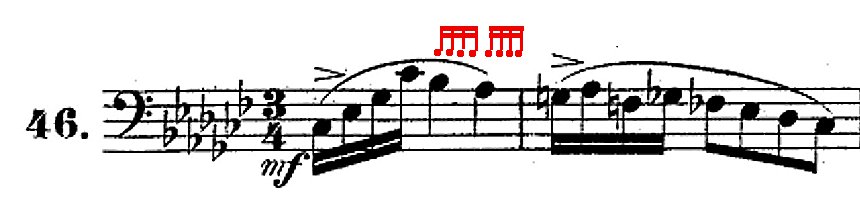
Rushing the quarter notes is the most common error in Weissenborn study #46. Continuing the 16th note subdivisions in your mind is vital for rhythmic accuracy in this study.
 Open full-size figure
0:48Ravel's Bolero and Subdivision
The sixteenth note subdivisions remind me of the subdivisions needed for the successful performance of Ravel's Bolero. If you are interested in practicing this excerpt, please see BDP# 95-96: http://www.2reed.net/bdp/home.html#bdp95
1:09Trill Fingerings
We have seen some of these trills before in the study, but let me give them to you again. Here is the trill in line 2, measure 4.
 Open full-size figure
1:14Section
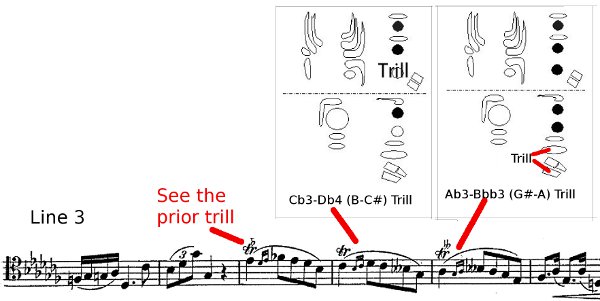
Here are the trills in line 3.
 Open full-size figure
1:25Alternate Gb3 Fingering
Of course I use the alternate Gb3 fingering for approaching and coming from Bb3. This has been discussed in a number of the earlier videos in the series so I won't mark the alternate fingering in this video. You should be familiar with this by now.
 Open full-size figure
Alternate Gb3 Fingering, continued
------------------------------------------------------------------------ # REFLECTION
1:48Reflection: Tools for Musical Development
In the prior videos on the Weissenborn studies I have introduced many different tools for practicing bassoon and also concepts for performing music. I hope that you are taking my guidance to heart and diligently applying the practice methods. In this series of videos I have sought to bring you the methods I have found most helpful for my musical development. As musicians we understand the value of daily practice. We know that musical changes often don't happen quickly, but come about with determined applications of careful practice.
2:29Tools for Emotional, Physical, and Spiritual Health
Likewise there are also tools available that will help you improve your emotional, physical, and spiritual health. Reading, studying, and memorizing portions of the Bible are great tools. Prayer to and faith in God are also indispensable. In addition, joining a group of other followers of Jesus will help you with your lifelong journey. All of these are tools that you can apply daily or weekly to help your emotional, physical, and spiritual health.
3:04Human Effort and the Power of God
However, I don't want to leave you with the impression that changes in life are solely dependent on human efforts. That is not the case! The recognition of God is an acknowledgment that there is a greater power. God can make changes in your life suddenly or slowly. Becoming a follower of Jesus is not simply a self-help journey. It is a step of faith that places you in the hands of the All-mighty God.
3:33Draw Near to God
Draw near to God and He will draw near to you. (NKJV, James 4:8)
3:41The First Step of Faith
If you are interested in learning more about the first step of faith please see my video on choices. http://www.2reed.net/choice/ ------------------------------------------------------------------------ # PERFORMANCE
3:49Performance Explanation
It's happened again. The recording I made several months ago is not suitable for presenting here. I apologize for giving you a recording that is not the same sound quality as in the Towson University Recital Hall. Unfortunately at this time at the end of the Spring semester, I don't have access to the hall. I am very anxious to finish this project so I don't want to wait more days for the hall to be available.
4:13Practicing with Subdivisions
I have been practicing this study with eighth note divisions on my metronome at the tempo of 168. It is even more effective, however, to keep 16th note subdivisions going. The higher sampling rate ensures greater rhythmic accuracy! Also I can still use a little rubato in the music with the subdivisions.
Credits
- author Terry B. Ewell
- composer Julius Weissenborn