Weissenborn Study #45
Weissenborn Opus 8/2, Study #45 for advanced bassoon
Comments
Weissenborn Opus 8/2, Study #45 for advanced bassoon students. Practice methods from Norman Herzberg and Frank Morelli. Faith makes a difference. By Terry B. Ewell, Bassoon Digital Professor. BDP #153.
The original transcript is available here.
Videos
Captions are unavailable. The complete transcript follows.
Chapters
Transcript
0:19Phrasing, Rubato, and Subdivision
Welcome, this is Terry Ewell. Weissenborn study #45 is another expressive delight in this collection. In the video on Weissenborn study #39 (BDP #147) I presented ways in which music can be shaped to create goals. Please review this video if you haven't seen it yet. To express phrasing you need to alter your dynamics, vibrato, and rubato. Using divisions of the beat to shape rubato is especially vital for this study.
0:58Rhythms in Line 3
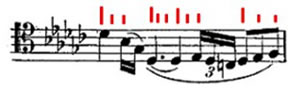
The rhythms in the last measure of line 3 require special attention. It is very important that you keep up the eighth-note divisions in order to properly perform the measure. Let's practice this slowly by setting the metronome to eighth notes values.
 Open full-size figure
1:34Alternate Eb3 Fingering
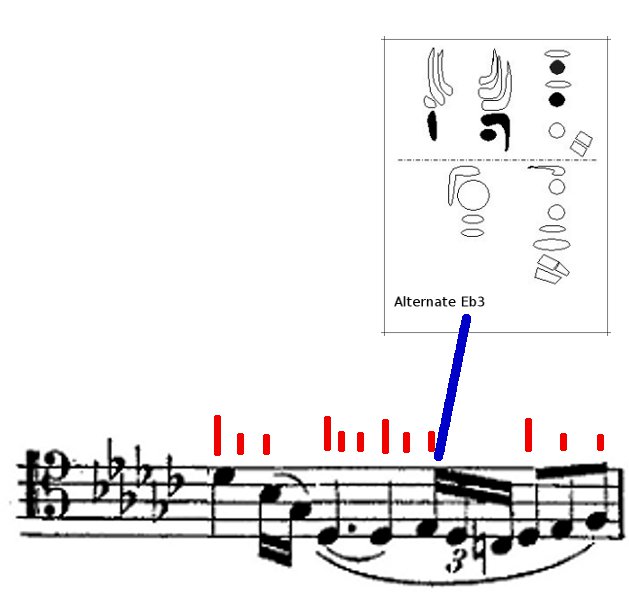
I use an alternate fingering for Eb3 in this measure. It is the trill fingering.
 Open full-size figure
1:45Hemiola
Have you heard of a hemiola? The third to last measure sets up pairs of eighth notes which imposed a meter with divisions of two instead of the divisions of three. This is a great example of a hemiola.
 Open full-size figure
2:02Holding the Last Note
Be sure to hold the last note to the end. Don't end the note too early.
 Open full-size figure
2:10Norman Herzberg and Simon Kovar Practice Method
This is a great study in which to employ other practice methods. Norman Herzberg presented to me years ago a method of practice which is a reduction of the fine collection of studies written by Simon Kovar. You can pick any three, four, or more notes for practicing in this way.
 Open full-size figure
2:32Three-Note Practice
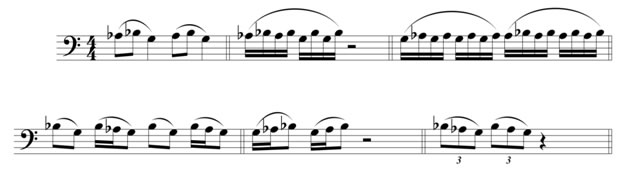
Let's take the three notes at the end of the second complete measure.
 Open full-size figure
2:36Section
Practice these three notes in various patterns at different speeds.
 Open full-size figure
 Open full-size figure
3:20Matching Timbre of Adjacent Notes
It is especially important to match the timbre or sound quality of adjacent notes. I am grateful to Frank Morelli for this practice suggestion. Let's take the same three notes and concentrate on timbre and smooth connections. I find that the connection between Ab3 and Bb3 is especially difficult. There needs to be precise and swift movements of the fingers to minimize the break between the notes.
4:21Pitch and Resonance of Bb and Ab
For instance, I find the pitch of Bb to be lower than Ab (when compared to equal temperament). So I need to make an adjustment for these notes to be in tune. Also Bb is a note with less resonance so I also need to adjust for greater resonance.
Open full-size figure
4:50Timbre, Embouchure, and Voicing
I've mentioned in prior videos that you can adjust timbre by means of the embouchure position on the reed. This is not something to do here! You don't have time to move the reed inside and out of your mouth on adjacent notes, particularly at faster speeds. Instead, there will be pitch and timbre adjustments made with the tongue position. This is also known as voicing or vowels. Shifting the embouchure on the reed is something you do for a section of music. Please see examples in the video on Weissenborn Study #50, part A, BDP #158.
5:35Developing Timbre
Drawing your attention to problems of timbre is an important first step to addressing the issue. In addition to vowel adjustments, you might also need to make adjustments to your reeds to better match the timbre of notes. Don't get too discouraged at first. This will take years of progress and dedication on your part. ------------------------------------------------------------------------ # REFLECTION
5:59Reflection: God Makes a Difference
...that you may know that the LORD does make a difference between the Egyptians and Israel." (NKJV, Exodus 11:7) But without faith it is impossible to please Him, for he who comes to God must believe that He is, and that He is a rewarder of those who diligently seek Him. (NKJV, Hebrews 11:6) My wife and I have faced a few difficulties in life. While living our first married years in Hong Kong our mortgage interest rate moved to over 20%. Our payments were not capped, so we had to cover this amount. Birth tests for our second child indicated that he might be born with a birth defect. We viewed his healthy birth as a gift from God. More recently my wife and I have both had various health issues. I am thankful that God makes a difference. He has listened to our needs and heard our prayers during our times of trouble. You have heard me speak in these videos about the difference that God has made in my life. In the videos on Weissenborn 36 and 37 (BDP #144-145), I mentioned the transformation that occurred for me as a person and a musician. I think that God can make a difference in your life as well.
Credits
- author Terry B. Ewell
- composer Julius Weissenborn