Weissenborn Study #48
Weissenborn Opus 8/2, Study #48 for advanced bassoon
Comments
Weissenborn Opus 8/2, Study #48 for advanced bassoon students. Overview of the Bassoon-Family Fingering Companion. Fingerings from the Bassoon-Family Fingering Companion: C#5 and D5. Reflection on the entrance to the Eastern Gate in Jerusalem. Musicians in Heaven. By Terry B. Ewell, Bassoon Digital Professor. BDP #156.
The original transcript is available here.
Videos
Captions are unavailable. The complete transcript follows.
Chapters
Transcript
0:16High Register Fingerings
Welcome, this is Terry Ewell. The last three studies in this collection explore the high register of the bassoon. I will devote some comments in each of the following tutorials to the new fingerings introduced in the studies.
0:33Collecting Bassoon Fingerings
Throughout college and my professional life I have been fascinated with all of the different fingerings possible on the bassoon. Some people collect baseball cards, some collect tea cups, but I collect bassoon fingerings!
0:52Bassoon-Family Fingering Companion
Several years ago the International Double Reed Society was kind enough to providing funding to help me with the production of an online collection of bassoon fingerings. At that time the online speeds were very slow so even simple graphics didn't move from servers to computers well. To aid with quicker access thus the bulk of this collection is in ASCII characters. My research assistant and I typed in almost every character in the collection. I hope that you will forgive the antiquated look of the database, but once you learn how to read the fingerings, you will have access to the most complete collection of bassoon fingerings available. http://www.idrs.org/resources/BSNFING/FINGHOME.HTM
1:40Features of the Fingering Companion
Let's take a look at the many features of the Bassoon-Family Fingering Companion. In the header you will find a Preface that provides an introduction to the database.
 Open full-size figure
1:53ASCII Fingering Representation
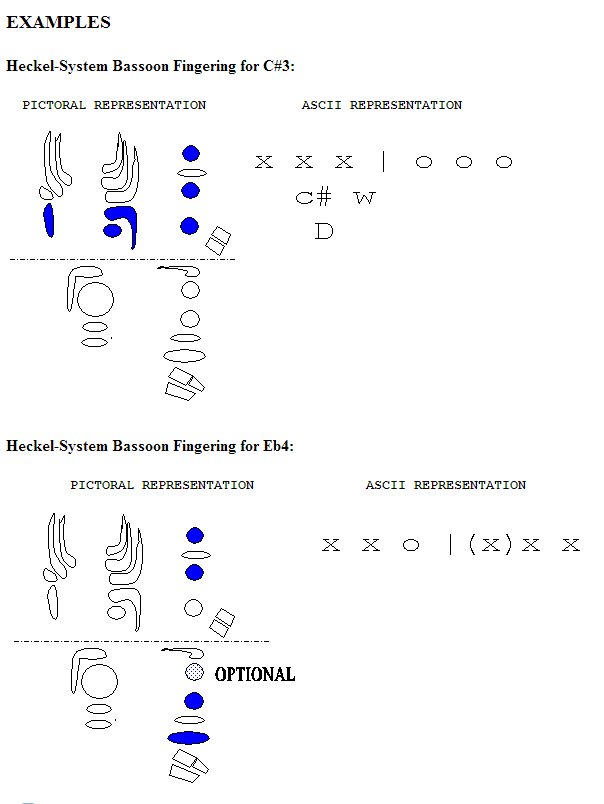
First let's take a look at the ASCII fingering representation.
 Open full-size figure
1:58Section
On that page is a graphic representation that is next to the ASCII coding. The ASCII coding is rotated 90 degrees for ease of typing. "X" indicates a covered hole or key. "O" indicates an open hole or key.
2:15ASCII and Pictorial Fingerings
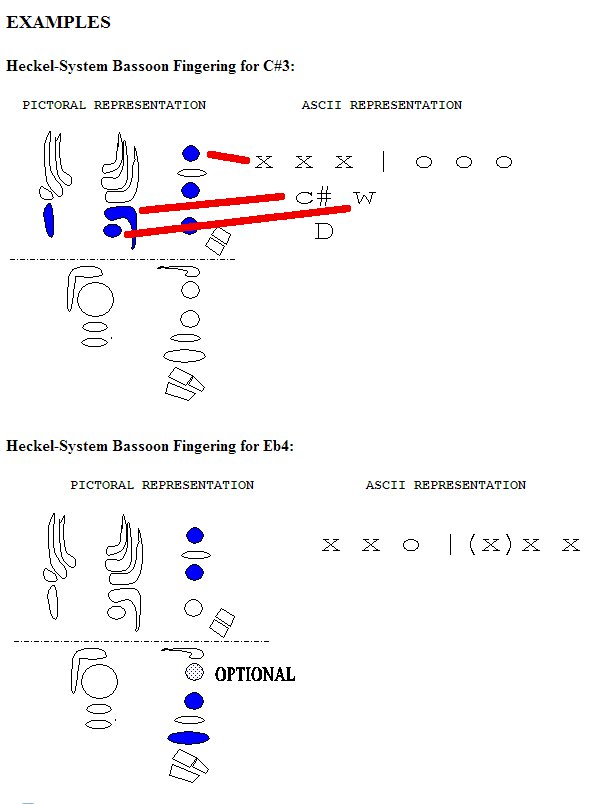
Here is the ASCII fingering representation aligned with the pictorial fingering. The top red line shows the covered top holes in each. The other lines show the C# and whisper keys in each.
 Open full-size figure
2:31Key Names
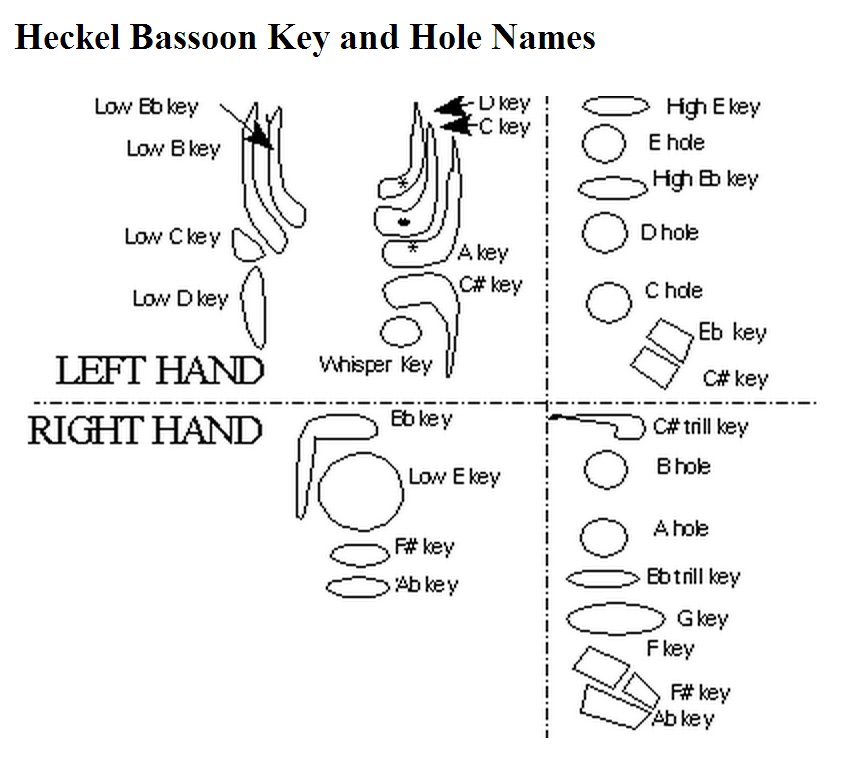
Now this is the ASCII representation rotated to appear as it does in the database. Here is a chart with the names of the keys. I encourage you to study the introductory materials more when you have time.
 Open full-size figure
2:47Database Overview
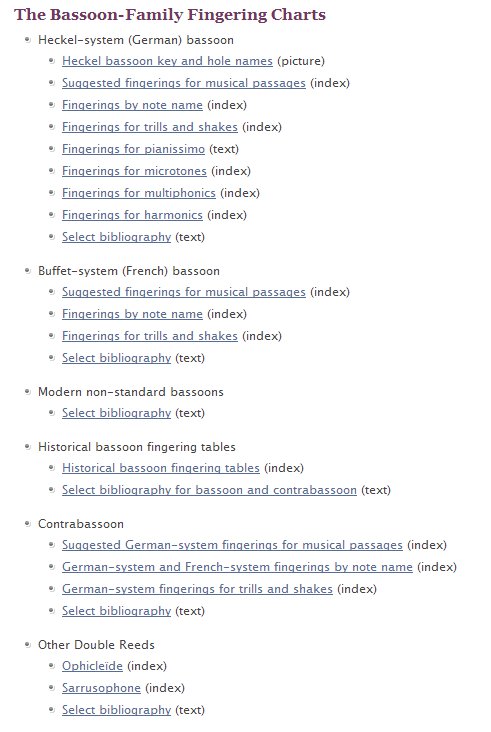
This is an overview of the site with links to portions of the database.
 Open full-size figure
2:54Section
I will start at the bottom and work up. Fingerings for other double reeds, German and French contrabassoon, historical bassoons, French bassoon, etc. are available. The portion of the database that is for the German system bassoon is at the top. There are suggestions for musical passages such as important orchestral solos for bassoon, but unfortunately when this portion migrated to the new IDRS website many of the graphics were lost.
3:29Fingerings by Note Names
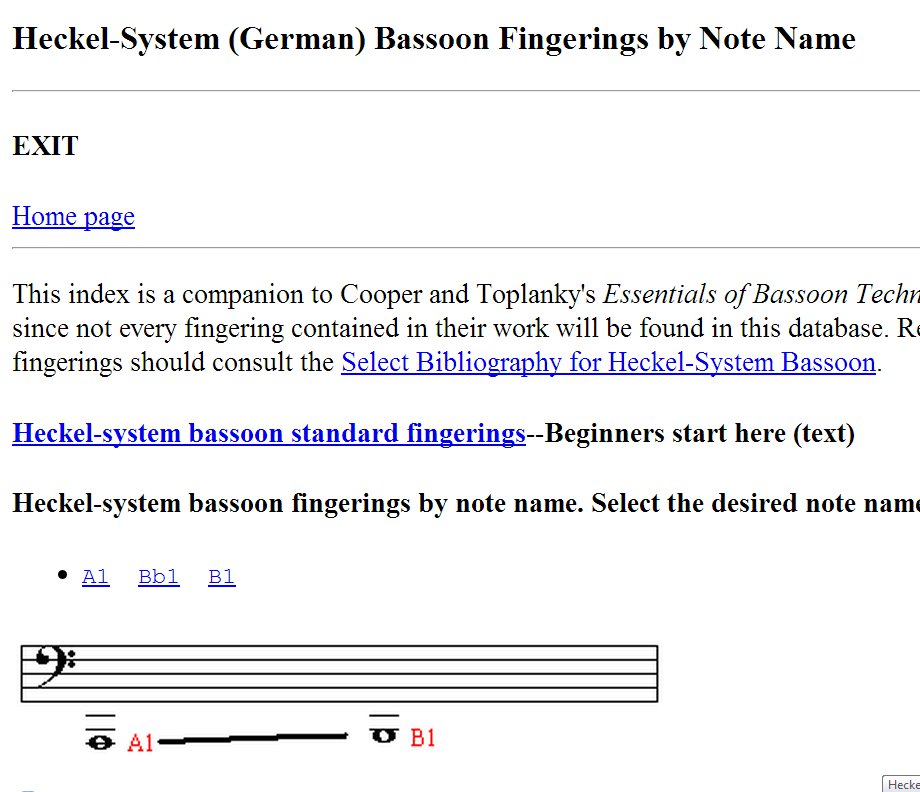
Select the "Fingerings by Note Names" to find a complete collection of fingerings for each note on the bassoon.
 Open full-size figure
3:37High Note Fingerings
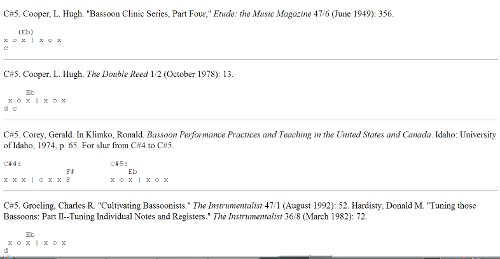
Scroll down to the bottom of the page and you will find high note fingerings up to C#6, which is an entire octave above the high note we are presented with in this study. Here is the top portion of the C#5 page. There are nine C#5 fingerings listed on this page. Notice that I credit each contributor and supply the references.
 Open full-size figure
4:03C#5 Fingering
My normal fingering for C#5 is this. Notice that I hold down both the D and C speaker keys.
 Open full-size figure
4:16Section
The addition of either the F or Ab key will increase resonance on C#5.
4:27D5 Fingering
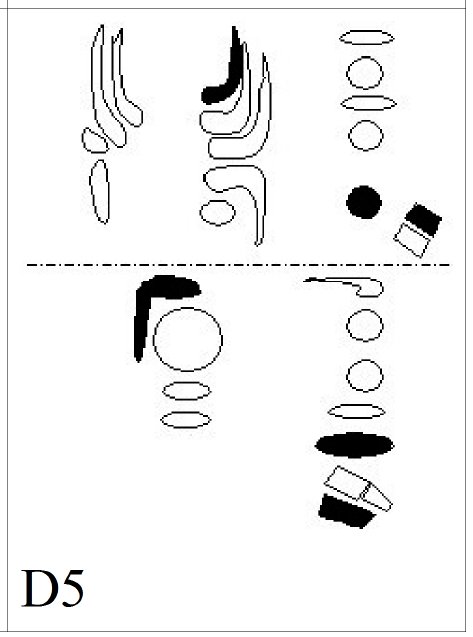
My normal fingering for D5 is this.
 Open full-size figure
4:31Short D5 Fingering
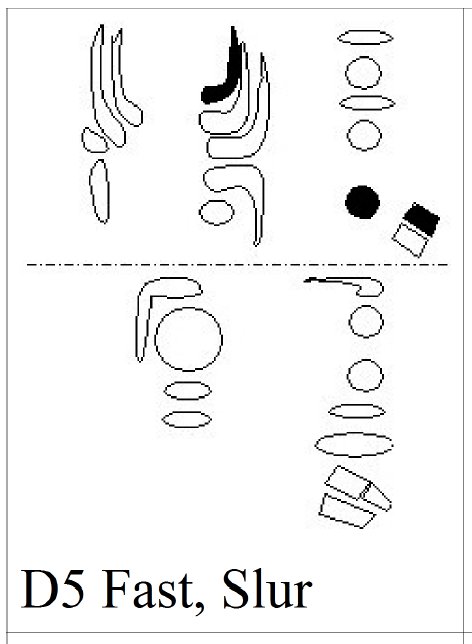
However, there are times when I use the "short" D5 fingering, especially for large slurs. You might find that this fingering works better for you.
 Open full-size figure
Short D5 Fingering, continued
------------------------------------------------------------------------ # REFLECTION
4:44Reflection: The King of Glory
Lift up your heads, O you gates! And be lifted up, you everlasting doors! And the King of glory shall come in. (NKJV, Psalm 24: 7)
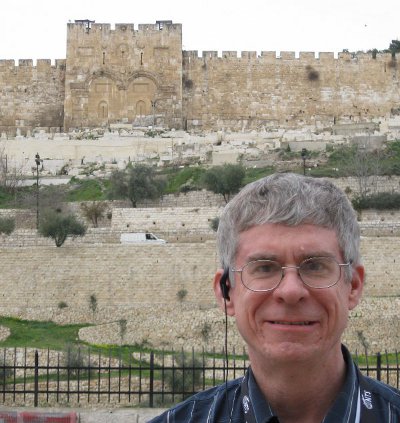
4:59The Eastern Gate in Jerusalem
Just recently my wife and I visited Israel. From the Mount of Olives we were able to view the Redemption Gate, also called the Eastern or "Golden Gate" entrance to the city of Jerusalem. You will notice that the gate is sealed. It will only be opened again when the Messiah, the redeemer comes.
 Open full-size figure
5:23Waiting for the Return of Jesus
Believers in Jesus are waiting for His return. He promised to set foot again on the Mount of Olives and then descend to the city of Jerusalem and enter through this gate.
5:37The Garden and Paradise
We began this series of videos with reflections on the first garden, the Garden of Eden. Believers are now waiting for the next garden to be placed on earth. It will be a wonderful place, a paradise. This is described in the last book of the Bible, Revelation chapters 21-22. I hope that you will read this!
6:01Musicians in Paradise
There will be much music in this new paradise. I close here by reading the last Psalm, which gives us a glimpse of musicians in paradise:
6:14Psalm 150
Praise the Lord! Praise God in His sanctuary; Praise Him in His mighty firmament! Praise Him for His mighty acts; Praise Him according to His excellent greatness! Praise Him with the sound of the trumpet; Praise Him with the lute and harp! Praise Him with the timbrel and dance; Praise Him with stringed instruments and flutes! Praise Him with loud cymbals; Praise Him with clashing cymbals! Let everything that has breath praise the Lord. Praise the Lord! (NKJV, Psalm 150)
Credits
- author Terry B. Ewell
- composer Julius Weissenborn