Seventh Bassoon Lesson, Part 2
Dynamics and phrasing. Studies by A Tune a Day, Rubank,
Comments
Dynamics and phrasing. Studies by A Tune a Day, Rubank, and Weissenborn. By Terry B. Ewell. BDP#196. www.2reed.net/bdp.
The original transcript is available here.
Videos
Captions are unavailable. The complete transcript follows.
Chapters
Transcript
0:00Intro Music: Home Sweet Home
Intro Music: "Home Sweet Home" from A Tune a Day, lesson 29 number 6.
0:13Applying Dynamics to Musical Examples
So let's now apply our use of crescendo and diminuendo to musical examples. Changing the volume of the music gives direction to the music, the musical motion. This is what we call musicality. "Crescendoing," "diminuendoing" is one part of musicality. We need to master that. So let's look at these examples here.
0:43Rubank Lesson 7, Number 6
Rubank Lesson 7, number 6 features four measure phrasing. I am going to aim to go to measure 3 in this first line. Example: Rubank Lesson 7, number 6.
 Open full-size figure
1:27Common Practice Phrasing
In what we call Common Practice music, that is music from Western Europe and even America, you find that in the Classical, Romantic, and even the 20th century; you find even measures of phrases. That is two, four, or even eight measures. These tend to be most typical.
1:51Section
In the first one in Rubank we had four measure phrases. I phrased to the middle of that phrase. It is usually towards the middle or near the end of the phrase that you will find the arrival point or the climax.
2:06A Tune a Day: Yankee Doodle
In this A Tune a Day lesson 16, number 5 we will see that "Yankee Doodle" is set up as two two-bar phrases followed by a four bar phrase. So I am going to phrase in that way. Creating nice unified gestures. Example: A Tune a Day lesson 16, number 5.
 Open full-size figure
2:48Arrival Points and Downbeats
Did you notice that my phrases, the arrival points coincided with downbeats. That is fairly typical. We find usually that the highlight (goal) of the phrase often is metrically stressed. A downbeat is metrically stressed or even harmonically stressed. Often in Common Practice music there will be chord changes, very significant changes, that occur on downbeats.
3:14Weissenborn Minuetto
Now the last one I want to play for you is from the Weissenborn, Bassoon-School, page 10, Minuetto. Now, this is interesting. We have four bar phrases, but we have upbeats into the phrases. This is also what we can an "anacrusis." Upbeat. So our four bar phrases instead of coinciding with measure lines, they are just a little bit askew. They start one beat early and end one beat early.
3:50Section
Here is the first line of that: Example: Weissenborn, Bassoon-School, page 10, Minuetto.
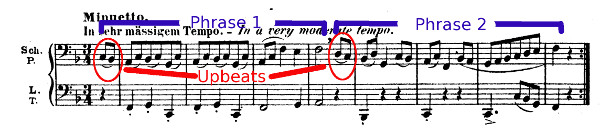 Open full-size figure
4:05Section
Let me play that for you slowly. Example: Weissenborn, Bassoon-School, page 10, Minuetto.
4:34Music as Conversation
Music is like conversation. It has meaning to it. It has gestures; it has motion. So, try to speak through your music.
4:44Further Study of Phrasing
As you become more familiar with music, you will learn where to phrase in the music. A good place to start your understanding of phrasing is with my video for Weissenborn's Study #38. Weissenborn Study #38
4:59Section
I also have videos in three languages on phrasing that are linked on my website 2reed.net. Check them out: Phrasing
5:10Section
Closing Music: "Home Sweet Home" from A Tune a Day, lesson 29 number 6. ------------------------------------------------------------------------ Copyright (c) 2016 By Terry B. Ewell. All rights reserved.
Resources
References
- Reference: Terry B. Ewell, “Teaching the Beginning Bassoonist,” The Double Reed 23/2 (2000): 35–43.here
Credits
- author Terry B. Ewell