Ninth Bassoon Lesson, Part 1
Using vowels for pitch control; bassoon registers and
Comments
Using vowels for pitch control; bassoon registers and voicing. By Terry B. Ewell. BDP#199. www.2reed.net/bdp.
The original transcript is available here.
Videos
Captions are unavailable. The complete transcript follows.
Chapters
Transcript
0:00Intro Music: Home Sweet Home
Intro Music: "Home Sweet Home" from A Tune a Day, lesson 29 number 6.
0:15Review of Pitch Control
By this time you are aware of a couple ways to control the pitch on the bassoon.
0:21Section
Remember the articulation experiments in lesson 3, BDP #33? In those experiments we charted the pitch response of more and less air and changes in the embouchure.
0:36Section
If you need to review this, here are the links for English and Chinese versions: English: Lesson 3, BDP #33 Chinese: Lesson 3, Chinese version
0:42Vowels and Voicing
In this lesson I will introduce a third pitch control component: changes in vowels. This is also called "voicing."
0:55Bb3 Vowel Experiment
The best way to illustrate this is to pick a rather unstable note on the bassoon, Bb3. Let's change the vowel in our mouth from "ee" to "ah."
1:08Section
"Ee" as in teeth and "ah" as in awful. When I play the note I don't speak the vowel rather I just move my tongue. I will try to do this without moving my jaw.
1:22Section
Example of changes in pitch with vowel changes on Bb3.
 Open full-size figure
1:31Section
Did you hear the difference in the pitch? Well, obviously. The "ee" vowel has a higher pitch than the "ah" vowel.
1:40The Vowel Spectrum
Now the "ah" and the "ee" vowels represent the extremes, the outer edges of that vowel spectrum, voicing spectrum. There are other vowels in between the two. I think that the one that best describes the middle ground is "oo" as in tooth or the German umlaut "ü." It is something in between the two (extremes).
2:06Practicing Ah, Oo, and Ee
Let's just practice that. Put your teeth together and practice going from "ah" to "oo" to "ee" and back and forth.
2:18Section
Example of "ah" -- "oo" -- "ee". It is hard not to move your lips there, isn't it?
2:32Section
If you cannot move your embouchure, your lips here and transition through those vowels, you get a real good idea of the different tongue positions that are possible.
2:43Bassoon Registers and Vowels
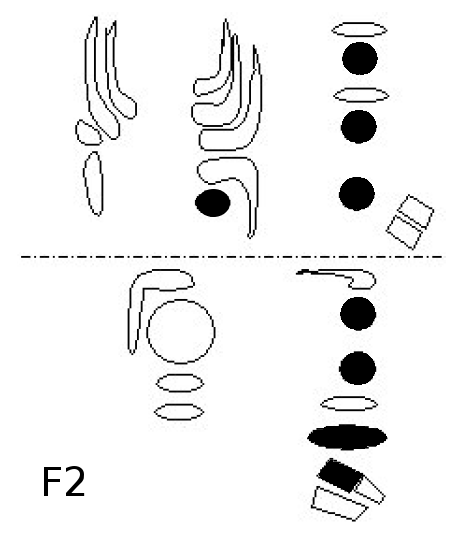
Now the bassoon has registers that move from darkest vowels---I will call "ah" the darkest vowel---to the brightest vowel "ee." The lowest note you have learned so far is F2.
 Open full-size figure
2:59First Register: F2 to E3
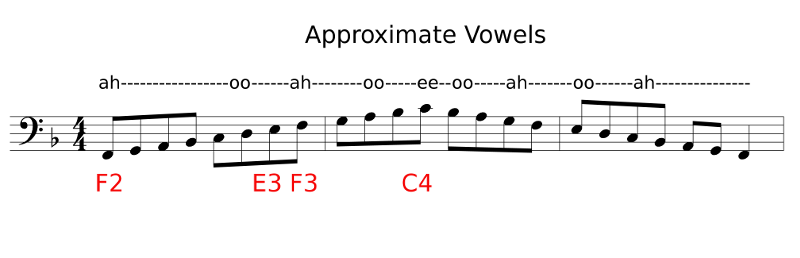
F2 definitely needs that "ah," that darker vowel. It keeps down the pitch and opens up the resonance.
3:09Section
As we move through that first register of the bassoon up to E3, we tend to move through and to brighter vowels. When I thinkg about it, I am not really quite at an "ee" vowel when I get to E3. Maybe it is more of an "oo," the transitional vowel.
3:30Second Register: F3 to C4
But when I get to F, F3, that tends to be a sharper note on my instrument so I have to drop back to a darker vowel, more of an "ah" vowel. Certainly the F#3 and G3 need to have that darker vowel that really drops the pitch. These are very sharp notes on our instrument.
3:53Section
Then very quickly for this new register, for the second register on the bassoon, I move up through the "oo" vowel. That is probably on the A. By Bb and certainly C4, which is flat, I am using the "ee" vowel.
4:12Section
So there are transitions. There is movement from the notes you know so far, from F2 up to E3. Starting again on F3 through the next register: "ah" through "oo" to "ee."
4:31F Major Scale with Vowel Changes
Let me play an F major scale, one and a half octaves, to illustrate the changes.
 Open full-size figure
F Major Scale with Vowel Changes, continued
Example: F major scale with vowel changes.
5:09Developing Pitch, Resonance, and Tone Color
Part of your development as a bassoonist will be to use your ear to tune each note, get a great sound, and get the maximum resonance on the note.
5:20Section
Listening to how embouchure, air, and vowels change each note will help you do this.
5:27Section
Now, this is going to take you many years to develop that full sound and have a great sound at all of the dynamics.
5:34Section
Keep in mind that the vowel changes, the voicings, can be a significant tool to use for tuning and also for color changes.
5:46Closing Music
Closing Music: "Home Sweet Home" from A Tune a Day, lesson 29 number 6. ------------------------------------------------------------------------ Copyright (c) 2016 By Terry B. Ewell. All rights reserved.
Resources
References
- Reference: Terry B. Ewell, “Teaching the Beginning Bassoonist,” The Double Reed 23/2 (2000): 35–43.here
Credits
- author Terry B. Ewell