Eighth Bassoon Lesson, Part 2
Dynamics and embouchure positions. Studies by A Tune a Day
Comments
Dynamics and embouchure positions. Studies by A Tune a Day and Rubank. By Terry B. Ewell. BDP#198. www.2reed.net/bdp.
The original transcript is available here.
Videos
Captions are unavailable. The complete transcript follows.
Chapters
Transcript
0:00Intro Music: Home Sweet Home
Intro Music: "Home Sweet Home" from A Tune a Day, lesson 29 number 6.
0:12Playing Quietly on the Bassoon
Now let's talk about playing quietly on the bassoon. In my first days as a student I had a lot of trouble playing quietly. Teachers told me "don't pinch the reed." They were right, this doesn't sound very good. Example sound with the reed pinched.
0:33Section
I agree, we shouldn't do that!
0:40Section
But how do you play quietly without closing the embouchure on the reed. Well, actually you do need to close the embouchure on the reed. You need have the proper balance of air and embouchure in order to play quietly.
0:57Three Principles for Quiet Playing
Here are a few steps that will be most helpful for students to play quietly on the bassoon:
1:04Section
1) A good sound will always have maximum air flow. Always support the sound well.
1:14Section
2) When you close the reed with the embouchure, consider cushioning the reed more---putting more lip surface on the reed.
1:24Section
3) Also pulling the reed out of the mouth slightly will also dampen the reed and give it a darker sound.
1:33Reed Vibrating Area and Volume
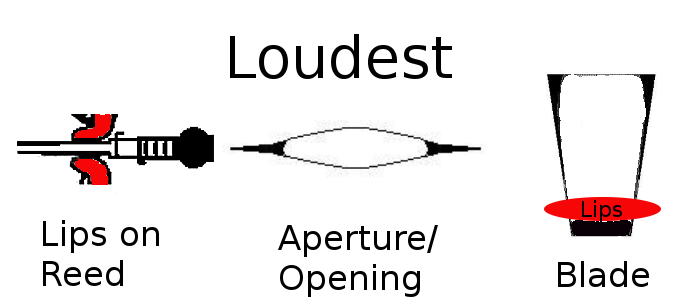
Let me explain a bit more how the surface area of the reed, the vibrating portion of the reed affects the volume. Think of the reed as a noise maker. The more you have vibrating, the louder the noise. The more surface that is vibrating, the louder the reed will become.
 Open full-size figure
Lips Near the First Wire, continued
In this figure I have the lips placed very close to the first wire. This means that almost all of the reed blade is vibrating. Where the lips are in contact, however, the vibration is dampened. But most of it is vibrating with the exception of the edges of the blade---the rails---are not vibrating. You can see that the aperture is very open here. It is only the very edges, the corners of the reed blade that are not vibrating.
 Open full-size figure
Lips Near the Tip, continued
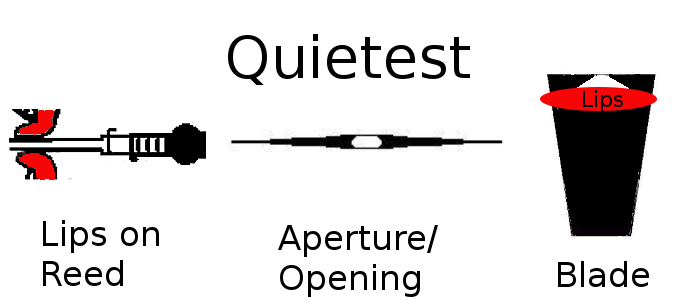
Now here is an example of the least vibrating area of the reed. The lips are slip right up to the edge of the blade where the aperture is. So everything beyond the lips towards the first wire receives some dampening. We only have the portion of the reed that in the front of the lips, the portion inside of the mouth that is vibrating. With the lips pressed down a little bit more you can see that that the aperture is very small. So it is only in the white area that we see vibration. You see dampening for the rest of the reed.
3:26Section
There is a contrast between the two: The least vibrating area where the lips are towards the tip and the most surface area vibrating where the lips are toward the first wire.
3:42Normal Embouchure Position
Now the normal position of my lips on the reed is more toward the middle of the reed. This allows me to change the timbre and by altering my lip position a little bit I can also change volume. Earlier in lesson 8a, in the Weissenborn page 12 you could see how I changed my lip positions a little bit on the reed and therefore alter the dynamics and the timbre of the tone.
4:15Weissenborn Page 12
Example from Weissenborn, p. 12.
 Open full-size figure
4:37Rubank Lesson 8, Number 6
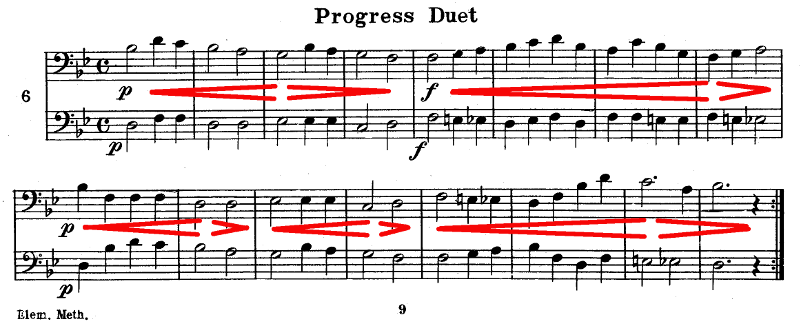
Now, let's apply the concepts for dynamics and musicality to this duet from Rubank's Elementary Method. This is lesson 8 number 6.
4:45Section
I will use the musical shaping that I have given in red. Example, Rubank Lesson 8, #6.
 Open full-size figure
5:43A Tune a Day Lesson 21, Number 7
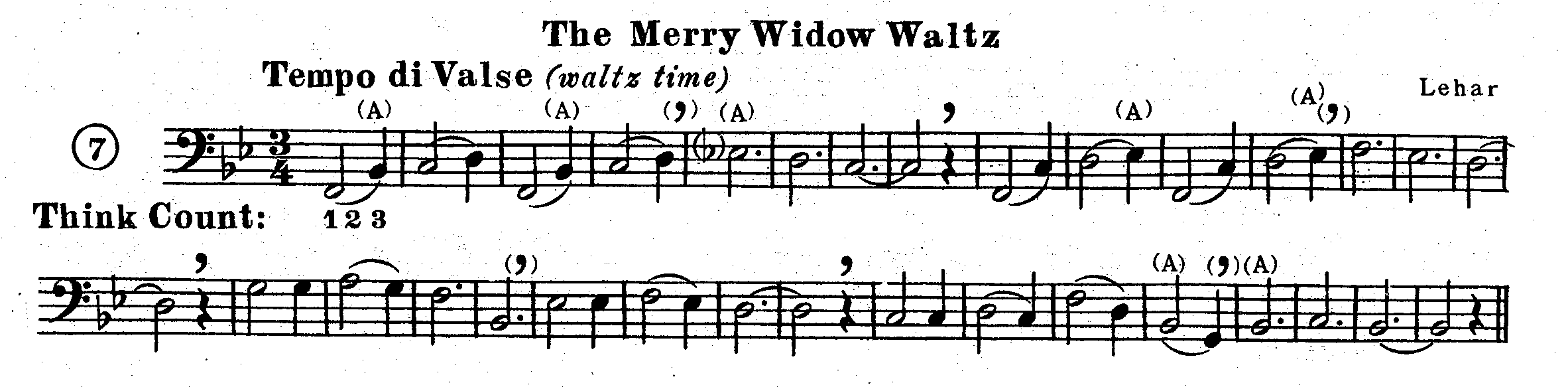
Now in A Tune a Day lesson 21 number 7 let's practice some more phrasing. It at all possible, don't breathe after bar 4. It is easiest to play this play this composition more in 1 than a slower 3.
 Open full-size figure
6:49Beautiful Melodies in A Tune a Day
What a lovely song that is. One of the things I like most about A Tune a Day is that it has some beautiful melodies from the European and American traditions. It is just enjoyable to play some of these beautiful melodies.
7:07Closing Music
Closing Music: "Home Sweet Home" from A Tune a Day, lesson 29 number 6. ------------------------------------------------------------------------ Copyright (c) 2016 By Terry B. Ewell. All rights reserved.
Resources
References
- Reference: Terry B. Ewell, “Teaching the Beginning Bassoonist,” The Double Reed 23/2 (2000): 35–43.here
Credits
- author Terry B. Ewell