Ninth Bassoon Lesson, Part 2
Comments on bassoon pedagogy and the presentation of
Comments
Comments on bassoon pedagogy and the presentation of teaching in the 200 BDP videos. Application of vowels or voicing to studies by Henry Paine, A Tune a Day, and Rubank. By Terry B. Ewell. BDP#200. www.2reed.net/bdp.
The original transcript is available here.
Videos
Captions are unavailable. The complete transcript follows.
Chapters
Transcript
0:00Intro Music: Home Sweet Home
Intro Music: "Home Sweet Home" from A Tune a Day, lesson 29 number 6.
0:12The 200th Bassoon Digital Professor Video
Well, I am grateful to recognize that this video marks the 200th video that I have made in the Bassoon Digital Professor Series.
0:27Section
I don't know if there will be another hundred coming because in these first two hundred I really have set out my pedagogy, my approach to teaching the bassoon.
0:40Bassoon Digital Professor Website
I want to bring to your attention that there is a website, www.2reed.net/bdp, that has all of my materials and videos.
0:49Section
It lays out the videos in a suggested order for your study.
0:58Overview of the Teaching Series
Primarily the twenty or so videos that are in this beginning bassoonist series followed by the over fifty videos that are in the Weissenborn advanced fifty studies series provide the comprehension overview of my teaching methods.
1:21Section
I hope that you will view those in order and that you will have an idea of what I consider fundamental for playing the bassoon.
1:30Section
I think that you will benefit from that.
1:32Studies in This Lesson
Now, let's move on to the studies in this lesson.
1:38Henry Paine, Page 13
Henry Paine, page 13, shows vowels for this study.
1:47Section
See the time signature in this study has a "C" and that means Common Time or 4/4 time.
1:56Section
He writes there, "Slowly---with full tone; think Ah."
2:01Section
So it is that "ah" vowel that we mostly use on the bassoon for that fuller tone.
2:07Section
This is particularly for the lower notes given in this study.
2:19Paine Example and Vowel Changes
Example: Paine, p. 13.
 Open full-size figure
2:53Section
Now I particularly have the sensation as I am going lower on the bassoon in this study that the vowel changes in my mouth and becomes much more that "ah" sound.
3:05Section
None of these notes necessarily really reaches an "ee," but it moves in that direction (for E3).
3:14Rubank Lesson 9, Number 2
Now in the next study, however, where we have some C4s and Bb3s, I do use the "ee" vowel.
3:26Section
These notes tend to be quite flat.
3:28Section
So let's look at the Rubank lesson 9, number 2.
3:33Section
I am just going to play for you the first few measures here.
3:38Section
The opening note, that F, has more of an "ah" vowel.
3:43Section
In measure 4 as I move up to the C natural, I am quickly moving from "ah" up to the "ee" vowel position with my tongue for the C4 and the Bb3 following.
4:01Section
Example: Rubank lesson 9 #2.
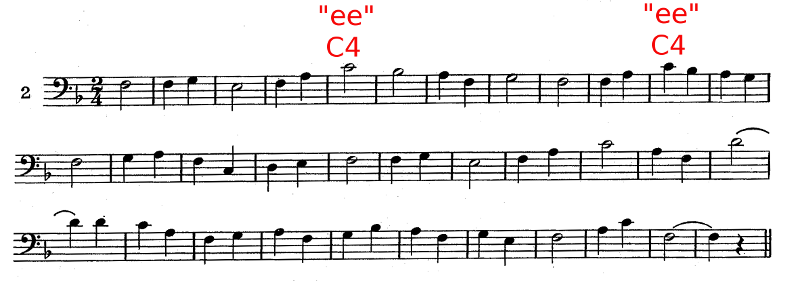 Open full-size figure
4:20Coordinating Bassoon Techniques
It is quite complicated playing the bassoon, isn't it?
4:21Section
You have to remember your flick keys, who have to remember to take off the whisper key, you have to change the vowel position, all of that.
4:28Section
So take your time.
4:30Section
Practice the techniques correctly right from the beginning.
4:33Section
Then you won't have to waste your time later doing that (correcting mistakes).
4:37Section
So practice carefull flicking of the A3.
4:40Section
Get up to the C with a flick, this is the C4 in measure 5.
4:46Section
Make sure that the vowel is an "ee."
4:49Section
All of that has to happen.
4:52The Blue Bells of Scotland
Let's look at a wonderful melody here, "The Blue Bells of Scotland" from A Tune a Day, page 26.
5:02Section
Concentrate on your vowels, your phrasing as you are playing this.
5:06Section
Play with a beautiful sound.
5:08Section
There isn't a dynamic given here so play it a good mezzo forte, play with a singing sound.
5:14Section
I don't think those numbers when I count, instead I think of pulses.
5:25A Tune a Day, Page 26
Example: A Tune a Day, p. 26.
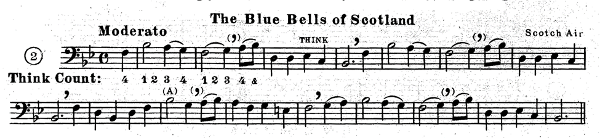 Open full-size figure
5:45Closing Music
Closing Music: "Home Sweet Home" from A Tune a Day, lesson 29 number 6. ------------------------------------------------------------------------ Copyright (c) 2016 By Terry B. Ewell. All rights reserved.
Resources
References
- Reference: Terry B. Ewell, “Teaching the Beginning Bassoonist,” The Double Reed 23/2 (2000): 35–43.here
Credits
- author Terry B. Ewell