Mozart's Bassoon Concerto, 4
Ornamentation 1, Introduction and Appoggiaturas
Comments
This video provides an introduction to the most common ornaments in the bassoon concerto. By Terry B. Ewell, Bassoon Digital Professor. BDP 215. Assisted by Vincent Igusa, bassoon and Catherine Renggli, piano. www.2reed.net.
The original transcript is available here.
Videos
Chapters
Transcript with Time Codes
00:00Introduction
Music: Vincent Igusa, bassoon, and Catherine Renggli, piano. Towson University Recital Hall, 20 June 2017. I have several recordings of the Mozart Bassoon Concerto in my vinyl collection. In addition, I also own several CDs of the Concerto. Despite the time and cost of creating all of these recordings, it appears that we still don’t have a recording of the work with all of Mozart’s notes and with style, ornamentation, and free embellishment appropriate to the Classical period. In this video we will discuss aspects of ornamentation and free embellishment. I hope that it will open your understanding on the topic. Perhaps you will be the person in the future to present the Mozart Bassoon Concerto in its full glory.
01:06Why Ornamentation Matters
Part of your education should include a study of ornamentation. This is especially needed since composers from the Baroque period produced volumes of works for the bassoon. Performers who present Baroque compositions without ornamentation are equivalent to Jazz musicians who perform Jazz without improvisation. Neither is historically correct.
01:37Ornamentation Resources
You might find helpful my video series on ornamentation. YouTube playlist: 2reed.net videos, music, and articles: Concert reviews and publications in the early 1700s into Schubert’s time in the 1820s and beyond indicate that vocalists regularly added free embellishments to the music, not singing exactly what was on the page. There is thus an unbroken tradition of free embellishment from the Baroque period through Mozart and to later composers in the early Romantic period.
02:12Nineteenth-Century Evidence
"In the nineteenth century, singers varied their performances much more broadly than twenty-first century vocal practices suggest. Vogl had his own personal style of performance, but it was related to nineteenth-century vocal practices. Vogl's manner coincided with instructions for realizing ornaments and introducing free embellishments found in nineteenth-century vocal treatises. In many cases, there was not a single correct way to realize embellishments in the nineteenth century; instead, there was a range of possibilities." Joseph R. Matson. Johann Michael Vogl's alterations to Schubert's "Die schöne Müllerin." University of Iowa, Spring 2009.
02:57Historical Sources for Ornamentation
Thus, an informed performance of the Mozart Bassoon Concerto must include ornamentation beyond that already written in the music. Here are some important publications from that time period to consider.
03:15Johann Joachim Quantz
Quantz, Johann Joachim. Versuch einer Anweisung die Flöte traversiere zu spielen. Versuch einer Anweisung die Flöte traversiere zu spielen On Playing the Flute, translated by Edward R. Reilly. London: Faber and Faber, 1966.
03:24Carl Philipp Emanuel Bach
Bach, Carl Philipp Emanuel. Versuch über die wahre Art das Clavier zu spielen. Versuch über die wahre Art das Clavier zu spielen, H.868, 870 Translation by William J. Mitchell. Essay on the True Art of Playing Keyboard Instruments. Ernst Eulenburg Ltd., 1974.
03:35Robert Levin Articles
Also of interest are these articles by Robert Levin: Robert D. Levin. "Improvised Embellishments in Mozart's Keyboard Music." Early Music 20/2 (May 1992), 221–233. Robert D. Levin. "Performance Prerogatives in Schubert." Early Music 25/4 (November 1997), 723–727.
03:44Frederick Neumann and John Miller
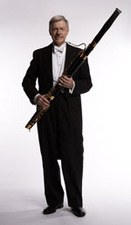
We should give special thanks to John Miller and his bassoon symposium for supplying us with an article by eminent scholar Frederick Neumann on works for bassoon. If you don't have time to read the texts I just recommended, you need to read the transcription by David Ross on a lecture given by Dr. Neumann. Ross, David J. "Ornamentation in the Bassoon Music of Vivaldi and Mozart," Part II. The Double Reed 9/3 (Winter 1986).
 Open full-size figure
04:12David Ross Article
This article provides a quick summary of ornamentation in Mozart's music for bassoon. An online version of the text is available through Archive.org. Ornamentation in the Bassoon Music of Vivaldi and Mozart The figures, however, are missing in this free version, so you need to gain access to the article either through joining the International Double Reed Society or by finding a copy of the journal.
04:42Italian Influence on Mozart
Neumann in his lecture makes an important observation that Italy rather than northern Germany provides the primary influence for ornamentation in Mozart's works. Mozart's father made three extended trips to Italy with the young Wolfgang between 1769 and 1773. Wolfgang's love of opera is further evidence of the influence of Italian composers. It is not surprising, then, that W. A. Mozart's music is characterized by vocal qualities, including choices of ornamentation.
05:27Neumann's Examples
The Neumann article includes many examples of ornaments in the Concerto. Time doesn’t allow for me to discuss them all, so I will just present one example in this video and one in the next. Please note that Neumann gives these as recommendations, not rules.
05:47The Appoggiatura
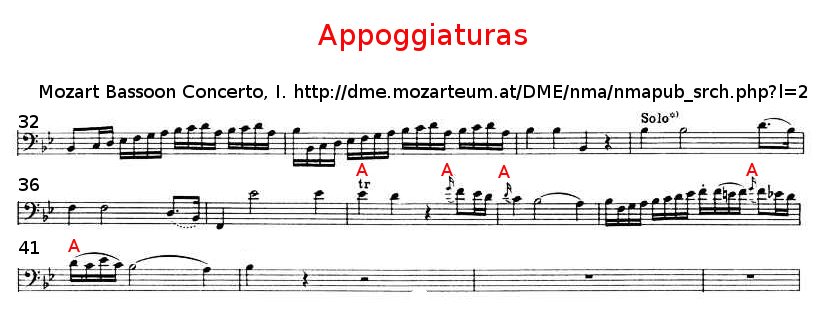
The most important ornament in Baroque, Classical, and even Romantic music is the appoggiatura. This ornament creates one of the most powerful expressive gestures in Common Practice music and often is the goal of musical phrasing. If you have time to study just one ornament, this is the one!
 Open full-size figure
06:09Quantz on the Appoggiatura
Quantz thinks so highly of the appoggiatura that it is listed first among all ornaments in his treatise.
06:15What Is an Appoggiatura?
The word appoggiatura comes from the Italian appoggiare, "to lean." Appoggiaturas are metrically stressed dissonances. Often these appear on downbeats. These notes have stress and weight.
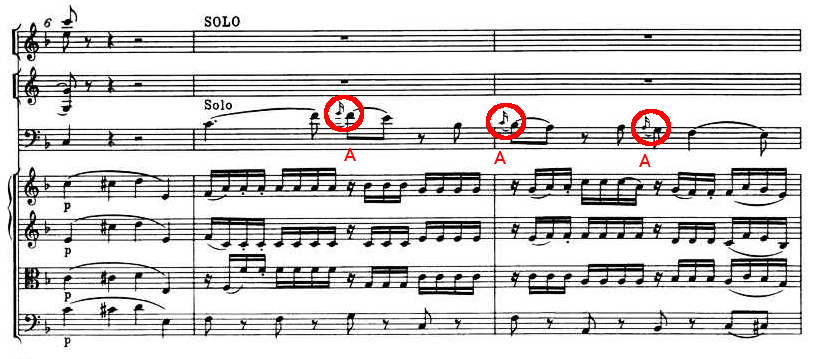
06:35Mozart's Second Movement
Let's examine the opening of the second movement bassoon solo. In the Urtext edition we find three grace notes, which here are placed in red circles with the main notes.
 Open full-size figure
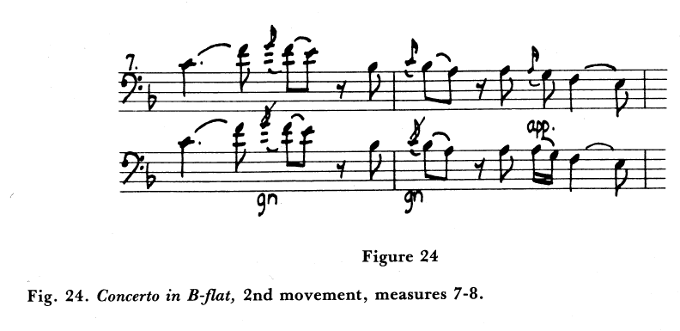
06:51Neumann's Interpretation
In figure 24, Neumann provides the Urtext edition on the top and his notation on the bottom. Although the notation on the top appears similar, the end result below is quite different.
 Open full-size figure
07:07Harmony Determines the Ornament
The first two grace notes are played before the beats. In the last example, however, the grace note is played on the beat. The only way to understand why this is the case is to examine the harmony. Note that the bassoonist needs to be aware of the notes in the other instruments, not just in the solo bassoon part! Without an understanding of the harmony, there cannot be an appropriate choice.
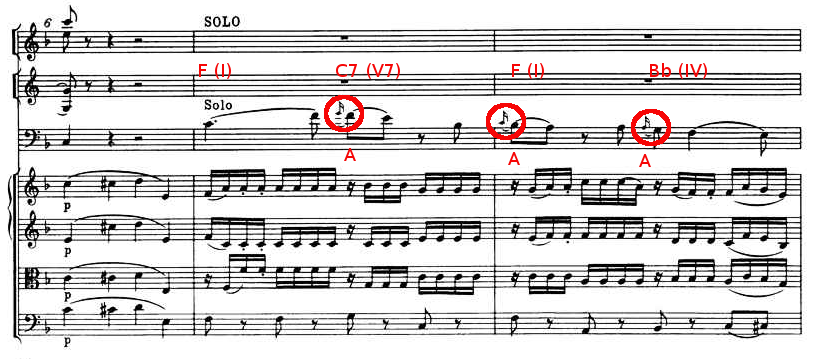 Open full-size figure
07:38Harmonic Analysis
Here is the Urtext edition with markings for harmony and appoggiaturas. The first grace note is a chord member. G4 is part of a C major chord. Thus, this note is not a dissonance and cannot be an appoggiatura. Appoggiaturas are always dissonances. Because the first grace note is not dissonant, it must be played before the beat. The second grace note is similar to the first; it is also not a dissonance. This grace note must also be played before the beat. The appoggiatura is on the B-flat and is already written into the music. The last grace note, however, is a dissonance and should therefore be played as an appoggiatura on the beat. It is a stressed note that is played with the value of a sixteenth note.
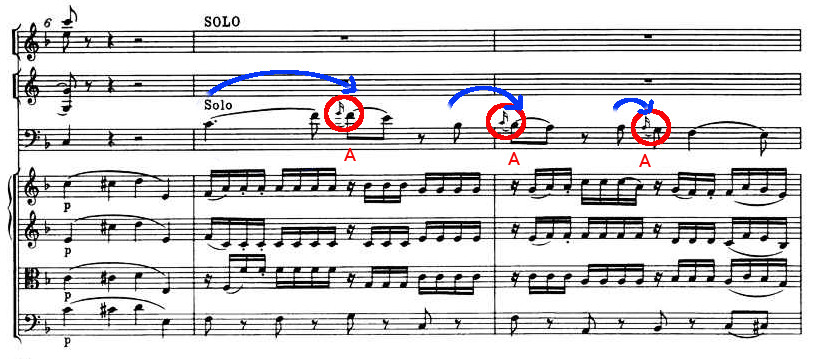 Open full-size figure
08:53Musical Gestures
Notice that the appoggiaturas are the goals of the gestures in the solo. The notes prior to the appoggiaturas musically lead to them. Although the last grace note in print appears to be less important than the surrounding notes, it should, in fact, be emphasized by the performer with significant weight.
09:26Next Video
In the next video we will examine appoggiaturas with trills. Music: Vincent Igusa, bassoon, and Catherine Renggli, piano. Towson University Recital Hall, 20 June 2017.
Resources
References
Credits
- author Terry B. Ewell
- bassoon Vincent Igusa
- piano Catherine Renggli
- Artwork and Graphics by Terry B. Ewell
- Copyright 2015-22 by Terry B. Ewell.
- Copyright (c) 2018 by Terry B. Ewell. All rights reserved.