Mozart's Bassoon Concerto, 5
Ornamentation 2, Trills and Eingangen
Comments
This is the second video on ornamentation, presenting trills, eingang, and other ornaments. By Terry B. Ewell, Bassoon Digital Professor. BDP 216. Assisted by Vincent Igusa, bassoon and Catherine Renggli, piano. www.2reed.net.
The original transcript is available here.
Videos
Chapters
Transcript with Time Codes
00:00Introduction
Music: Vincent Igusa, bassoon, and Catherine Renggli, piano. Towson University Recital Hall, 20 June 2017. This is our fifth video in the series on Mozart's Bassoon Concerto. I will summarize the presentations so far with two questions.
00:31Are You Playing All of Mozart's Notes?
The first question is, "Are you playing all of the notes and markings Mozart wrote?" I hope the answer to this question is "yes." The first video in the series established the best editions, those closest to Mozart's autograph. In order to play what Mozart wrote, we obviously need to examine an Urtext edition. The second video addressed the "missing notes," those tutti section notes written for bassoon that are ignored by most performers of the Concerto. Thus, we established all of the notes and markings given by Mozart.
01:22Are You Playing Only Mozart's Notes?
The second question is, "Are you playing only the notes and markings Mozart wrote?" I hope that the answer to this question is "no." The third video presented the need to add articulations beyond those given by Mozart. The fourth video presented information on ornamentation and elaborations given by the performer. Both of those videos advocated adding notes and markings beyond what was given in the Urtext edition. This video continues the careful examination of what was written by Mozart, how to stylistically perform it, and also what notes could and should be added. Thus, in this video and the next we will further establish the need to add new music in a performance of the Concerto. In a sense, the performer is a co-composer of the Bassoon Concerto.
02:30Beginning Trills
I have often heard the rule that all trills in Mozart's music should start with appoggiaturas, that is, with notes a step above the main notes on the beat. Neumann makes the point, however, that it is not essential to begin every trill in Mozart's music with an appoggiatura.
02:53Neumann's Recommendations
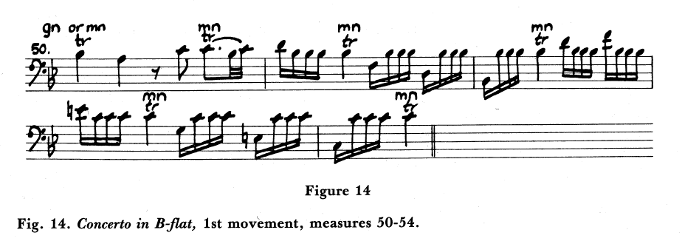
In the last video we clarified the difference between grace notes and appoggiaturas and when they should occur. Here again we see the same principle in practice. Neumann indicates that the first trill could start with a grace note (C4) or on the main note (B♭3). Notice that this cannot be an appoggiatura, since the B♭3 is already the dissonance. If the main note of the trill is already an appoggiatura, then either a grace note before the beat could be given, or the trill should start on the main note. The rest of the trills he recommends starting on the main note. I prefer to add an appoggiatura to the C4 trill at the end of measure 50, however. Ross, David J. "Ornamentation in the Bassoon Music of Vivaldi and Mozart," Part II. The Double Reed 9/3 (Winter 1986).
 Open full-size figure
03:53Trill Terminations
Mozart has written a Nachschlag or termination to the trill at the end of measure 50. Terminations are not written for the rest of the trills. My preference is to start each of those trills on the main note and without terminations. This provides better clarity for the line D4, B♭3, F3, D3, and B♭2.
04:25Trills after Large Leaps
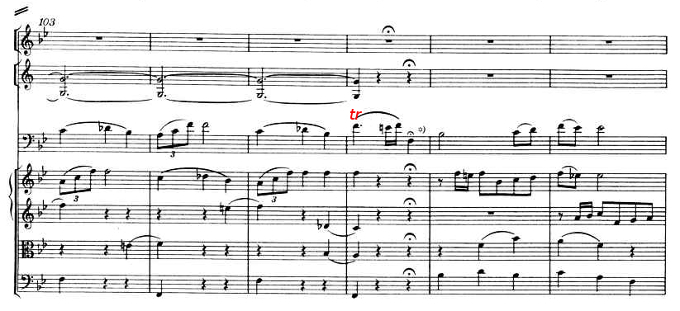
There are other guidelines for trills: how they are approached. If there is a large leap to a trill, often it is best to begin the trill on the main note to clarify the interval. Measure 106 of the third movement of the Concerto provides a good example of this. This approach, I think, ties in best with the vocal quality of Mozart's music. If an interval with the added appoggiatura is not easy to sing, then starting the trill on the main note is preferred.
 Open full-size figure
05:09Stepwise Approach to Trills
If the trill is approached stepwise from above, then the trill should also start on the main note. Measure 88 in the first movement provides an example of this. The choices with ornamentation I provide in the rest of this video are not intended to be rules for performance. Rather, I hope that they stimulate ideas for you and that you will create a version of ornamentation for the Concerto that is unique. The Concerto is a living musical expression, one that should be adapted by the performer within the constraints of the style and practice of the period. Don't just be an imitator; be original.
05:58The Eingang
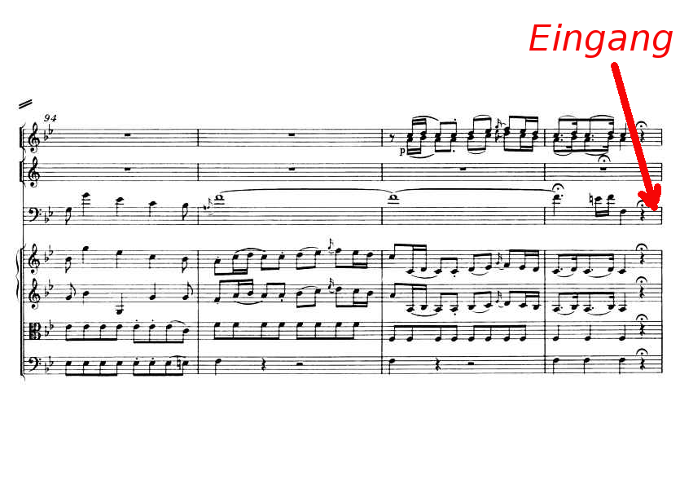
The Eingang, or lead-in passage, is very important in the Concerto, both as an introduction to a structurally important tutti section and as an expression of artistry. Neumann defines an Eingang as an introductory passage that leads into a theme. An Eingang is needed in the first movement in measure 97 to lead into the orchestral tutti section. Notice that it is signaled with a fermata.
 Open full-size figure
06:40Example of an Eingang
Here is one of my examples of the Eingang for the first movement. Vincent's Eingang is a variation on mine.
 Open full-size figure
06:53Eingang in the Third Movement
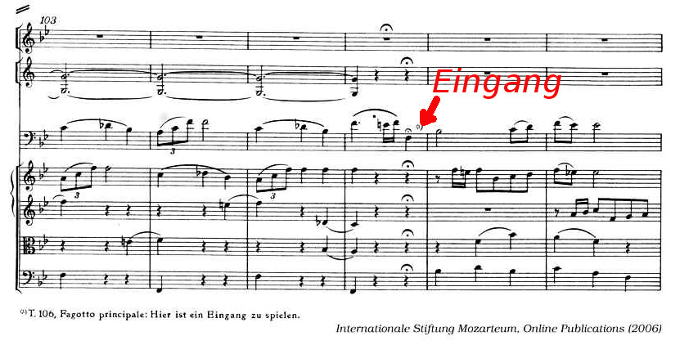
There is also an Eingang needed in the third movement in measure 106. Again, the fermata is an indication that additional music by the soloist is required here. Notice at the bottom of the score the editor even points out the requirement to add the lead-in!
The Eingang before the third movement tutti.
07:18Third Movement Eingang Example
Here is my Eingang for the third movement.
 Open full-size figure
07:27Ornamenting Repeated Material
I add further ornamentation in the second movement, which is unique to my performance of the Concerto. It was typical in the Baroque period for musicians to ornament musical repetitions or sequences. This adds interest to the music.
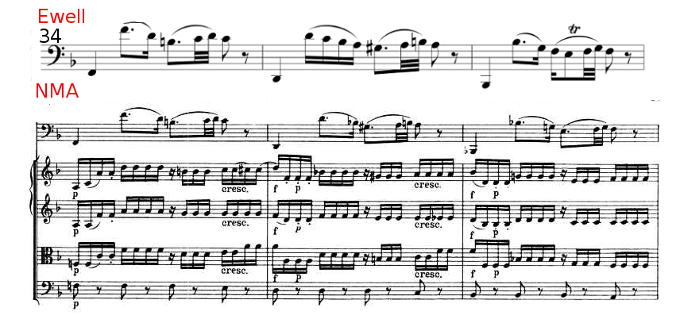 Open full-size figure
07:53Concluding Flourishes
Last of all, adding concluding flourishes with scales or arpeggios is appropriate at important cadences which signal the end of a section. Here is the flourish I played in my performance of the Concerto about three years ago.
 Open full-size figure
08:16Traditional Ending
Here is a traditional ending, which Vincent performs in measure 150.
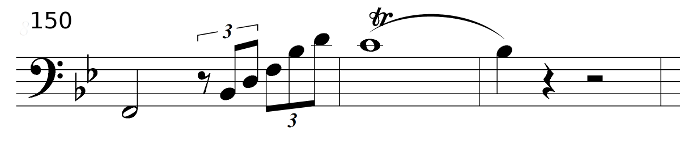 Open full-size figure
08:23Next Video
Our last consideration of embellishments to the Concerto will be in the next video, where we examine writing cadenzas. Music: Vincent Igusa, bassoon, and Catherine Renggli, piano. Towson University Recital Hall, 20 June 2017.
Credits
- author Terry B. Ewell
- bassoon Vincent Igusa
- piano Catherine Renggli
- Artwork and Graphics by Terry B. Ewell
- Copyright 2015-22 by Terry B. Ewell.
- Copyright (c) 2018 by Terry B. Ewell. All rights reserved.