Mozart's Bassoon Concerto, 7
Cadenza 2, Writing the Conclusion
Comments
This video discusses how to write the conclusion to a cadenza. By Terry B. Ewell, Bassoon Digital Professor. BDP 218. Assisted by Vincent Igusa, bassoon and Catherine Renggli, piano. www.2reed.net.
The original transcript is available here.
Videos
Chapters
Transcript with Time Codes
00:00Introduction
Music: Vincent Igusa, bassoon, and Catherine Renggli, piano. Towson University Recital Hall, 20 June 2017. Welcome to our seventh video in the series on Mozart's Bassoon Concerto. I am Terry Ewell.
00:27Improvised and Written Cadenzas
Documents from Mozart's time period and before indicate that many performers improvised their cadenzas, that is, they created the music at the moment. There are performers today who do this as well, and they are to be congratulated for this. For me, however, the stress of just performing a prepared cadenza is enough. For this reason, ahead of time I carefully craft my composition.
01:08Guidelines for Cadenzas
Let's review quickly guidelines about the cadenzas. 1) Style. The cadenza should match the style of the music (harmony, melody, rhythms, expression, technical character). 2) Quotation. The cadenza should make use of materials contained in that movement of the concerto. 3) Brilliant passage work. The cadenza should showcase the performer's abilities. To this, you might want to add a fourth guideline. 4) Historically informed. If desired, conform with historical "authenticity."
01:56Historical Authenticity
For instance, you might want to limit the bassoon part to what could be played on an instrument from that time period. This would mean, for instance, limiting the high register range of the instrument to B♭4, the highest note that Mozart wrote in his concerto. Definitely the high F, F5, in Ibert's cadenza would be ruled out!
 Open full-size figure
02:27Mozart's Own Cadenzas
Examples of cadenzas from the Baroque and Classical periods are shorter in length than those found in the late 1800s and 1900s. For instance, consider this second movement cadenza written by Mozart for the A Major Piano Concerto. This cadenza is from a collection of thirty-six cadenzas written by Mozart. I encourage you to study them as you start writing your own cadenzas. 36 Cadenzen für das Pianoforte von W. A. Mozart, Köch. Verz. No. 624. Leipzig: Breitkopf und Härtel, 1878. http://imslp.org/wiki/36Cadenzas%2CK.624%2F626a(Mozart%2CWolfgangAmadeus)
03:01John Corina's Approach
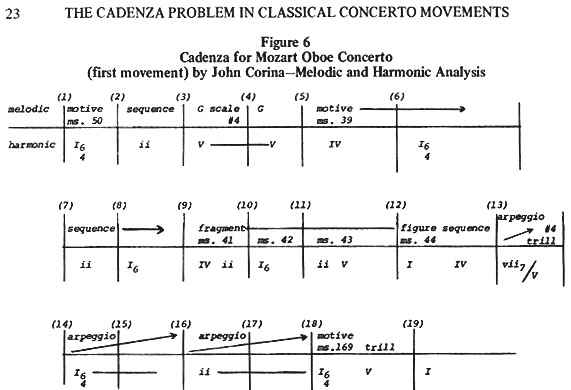
In addition, I want to mention an article by composer and oboist John Corina on writing cadenzas. In his article he advocates writing a cadenza by adopting the harmonies created by Mozart in this collection and then using that harmonic framework to create a new cadenza. For instance, he takes the harmonies from Mozart's Cadenza No. 15 and then uses them for the Mozart Oboe Concerto. Corina, John. "The Cadenza Problem in Classical Concerto Movements," Journal of the International Double Reed Society, vol. 3 (1975). http://www.idrs.org/publications/controlled/Journal/JNL3/cadenza.html
 Open full-size figure
03:35Three Parts of a Cadenza
You might find this approach quite helpful. However, I prefer an approach that is less prescribed, which is presented in this and the next video. For our purposes here, let's consider our cadenza in three parts: 1) the opening statement, 2) the middle section which contains at least one sequence and other flourishes, and 3) the conclusion.
04:35Begin at the End
Instead of just writing the cadenza from the beginning to the end, I suggest that you try writing it from the end first. This might help your creative process. Let's first consider the conclusion to the cadenza.
05:04Mozart's Cadenzas
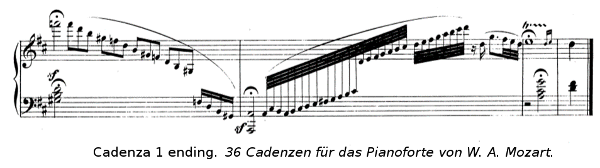
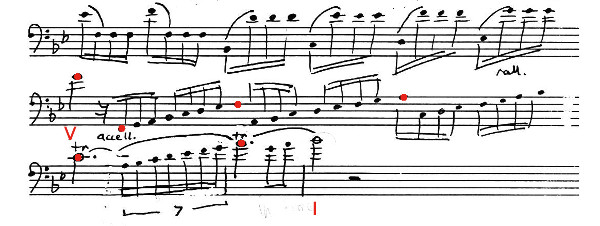
Notice how Mozart sets up the conclusion to these cadenzas. In the conclusion, there does not need to be a direct quotation from the Concerto. Rather, these sections feature florid scales and arpeggios in the style of the composition. In Cadenza No. 1, a prominent A octave is given in the bass. This serves as a pedal tone and is on the fifth scale degree of D major, the key of this concerto. From that point a cadential 6/4 or dominant seventh chord is implied by the scale and the ending figure. The trill ends on a V7 chord leading to the tonic when the orchestra would enter.
 Open full-size figure
06:10Mozart's Fifteenth Cadenza
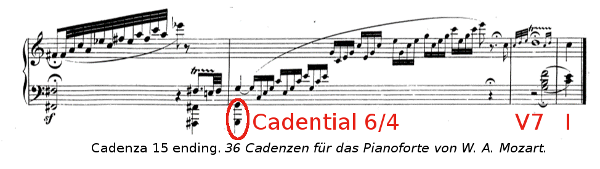
We find much the same approach given in the ending of the fifteenth cadenza. Notice that the dominant, here G, is emphasized in the bass, followed by arpeggiated figures for a cadential 6/4 chord which lead again to the V7 and the I. The ninth cadenza follows the same pattern as well.
 Open full-size figure
Ending of Mozart's Cadenza No. 9.
06:42Creating Your Own Ending
To create a cadenza ending, begin by identifying the dominant of the key signature and creating a pedal tone section that implies the harmony of the cadential 6/4 or the dominant chord. Since single-line instruments cannot provide the V7 during a trill, as Mozart does with the piano, I find that presenting the dominant or dominant seventh in this conclusion is particularly effective.
07:16Terry Ewell's Example
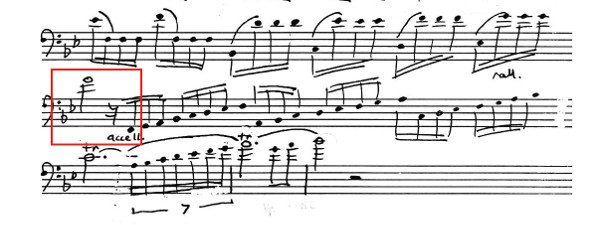
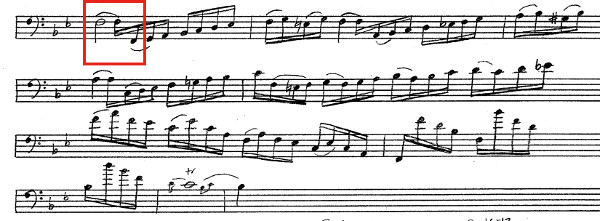
In my cadenza, I create the dominant pedal tone area by first giving a half note on F, which is the dominant of B-flat, the key of the concerto. I then emphasize it in the lower octave to establish that F as the pedal tone of this last section. See the notes in the red box.
 Open full-size figure
07:47Dominant Harmony
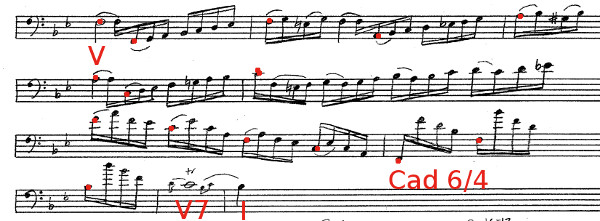
I then emphasize the dominant chord—F, A, and C— throughout the conclusion. I have highlighted some of the chord members that are most heavily emphasized. Vincent sets up the dominant pedal in a manner similar to my cadenza.
 Open full-size figure
 Open full-size figure
08:11Vincent Igusa's Harmonic Plan
The harmony of his ending is, however, a bit more complicated. Much of the conclusion is devoted to the dominant chord through either metrically emphasized notes or arpeggios. Briefly, however, the cadenza returns to the cadential 6/4 before implying the dominant seventh conclusion on the trill.
 Open full-size figure
08:37Write Your Own Cadenza Conclusion
Now that you have seen several examples of conclusions to cadenzas, try writing a few now. Once you have done that you will be ready to view the next video, where I will discuss writing opening statements and the middle sections of cadenzas.
09:11Closing Performance
Music: Vincent Igusa, bassoon, and Catherine Renggli, piano. Towson University Recital Hall, 20 June 2017.
Credits
- author Terry B. Ewell
- bassoon Vincent Igusa
- piano Catherine Renggli
- Artwork and Graphics by Terry B. Ewell
- Copyright 2015-22 by Terry B. Ewell.
- Copyright (c) 2018 by Terry B. Ewell. All rights reserved.