Mozart's Bassoon Concerto, 8
Cadenza 3, Writing the Opening and Sequence
Comments
This video provides an introduction to the most famous bassoon concerto and which editions to use for studying and performing. By Terry B. Ewell, Bassoon Digital Professor. BDP 219. Assisted by Vincent Igusa, bassoon and Catherine Renggli, piano. www.2reed.net.
The original transcript is available here.
Videos
Chapters
Transcript with Time Codes
00:00Introduction
Music: Vincent Igusa, bassoon, and Catherine Renggli, piano. Towson University Recital Hall, 20 June 2017. Well, wonderful. This will be our last video on writing a cadenza for the first movement of Mozart's Bassoon Concerto. In Video 6, I presented three cadenzas and we considered how best to match the style of cadenzas in Mozart's period. Video 7 introduced the idea of having a harmonic plan for the cadenza and we have seen some possible conclusions to the cadenza. Now in this video, number 8 in the series, we need to consider the opening and the middle sections of the cadenza.
00:54Collecting Musical Ideas
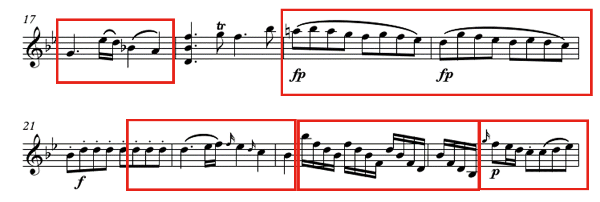
I suggest that you begin writing the opening and middle section of your cadenza by collecting some melodic fragments from the bassoon or orchestral parts. For instance, here are some ideas to consider.
01:16Melodic Fragments
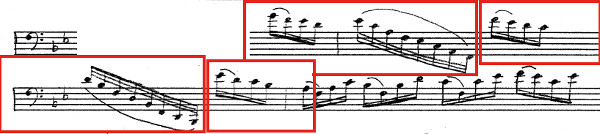
I have placed in red boxes possible ideas for the cadenza. Look at how rich these eight measures are! There are more ideas here than needed for an entire cadenza. You could choose other ideas throughout the movement as well. With so many ideas and possibilities, there are almost unlimited ways to construct a cadenza for this movement.
 Open full-size figure
02:02Opening Statements
Usually Mozart's opening statements in his cadenzas do not duplicate the opening statement in the solo instrument. Mozart, however, provides two B-flat 3s, which appear to reference the opening statement in the solo bassoon part. Starting either by quoting the opening statement or another section would be appropriate.
02:28Beginning from the Cadential 6/4
The opening statement needs to start well from the cadential 6/4 chord, in this case a B-flat major chord. So, the safe thing to do is to start by outlining the chord in your melody.
02:52A New Opening Statement
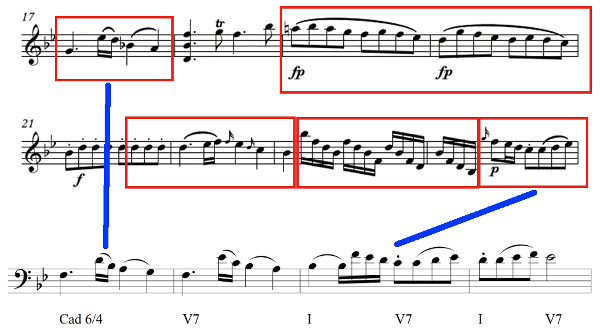
In this figure you see the violin parts at the top and a new opening composed for this video. Notice that I start with the cadential 6/4 chord, using F, B-flat, and D, and make use of the rhythm and contour of the first fragment in the violin part.
 Open full-size figure
03:18Developing the Opening
See how that idea is elaborated a few times. Here I decided to move the upper note in each by a step to create an appealing melody with direction. After the third repeat, it is time to break off with something else, so I decided to imitate the last melodic fragment in the violin example for that passage. I end with a V7 harmony in mind, setting up a more virtuosic section in the tonic key.
04:03Vincent Igusa's Opening
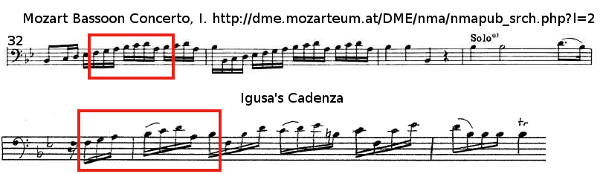
Here is how Vincent's opening statement borrowed from measure 32 in the tutti section. He then borrows from the bassoon part in measure 51 in the last measure of the example.
 Open full-size figure
04:20Planning the Middle Section
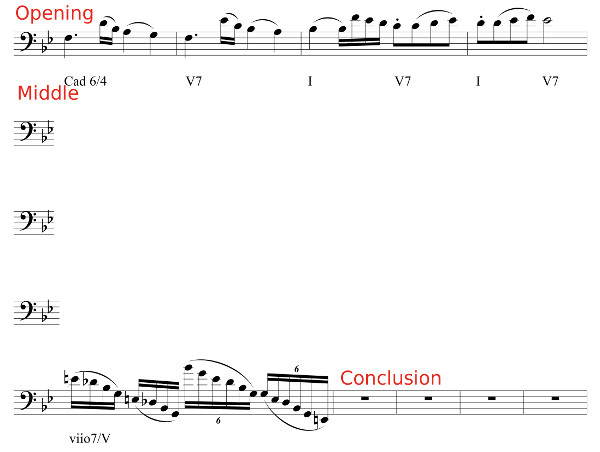
So, my framework for the middle section is on the screen. You can see the opening section we created, the blank space for the middle section, and then a diminished seventh chord leading to the conclusion. I really like the idea given in Mozart's first cadenza where he approaches the pedal tone with a diminished seventh chord, so let's end my middle section with that chord.
 Open full-size figure
05:01Sequences in the Middle Section
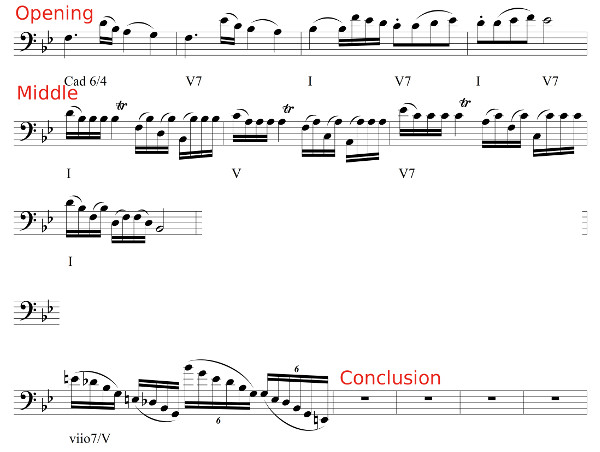
Sequences and repetition are important features of middle sections in Classical cadenzas. I have decided to start with the trill section in the bassoon solo at measure 51, but I will vary it just a bit. Then I will repeat it down a step, adjusting the notes to fit a V7 chord. Another repetition, higher in the V7 chord, continues it, and then I return back to the tonic, I. The adventure wasn't too far; I have returned safely back to "home."
 Open full-size figure
06:01A Second Musical Idea
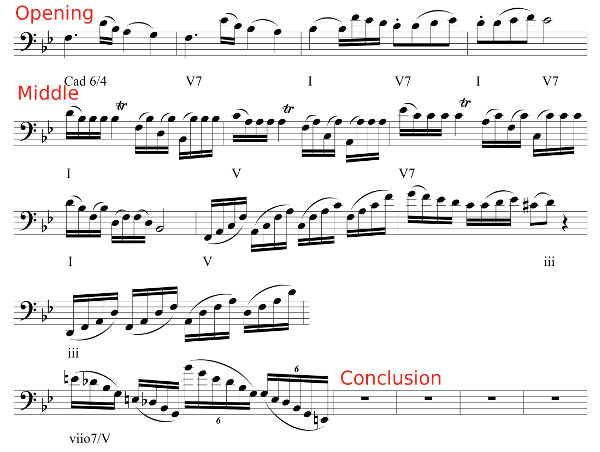
Now we need something else. I have already used that idea enough. Let's use the last two ideas in the string part, but instead of the arpeggios going downward, I need them to ascend. Since I end on a D in the first statement, it is quite nice to start on a D in the second statement.
 Open full-size figure
06:50Completing the Middle Section
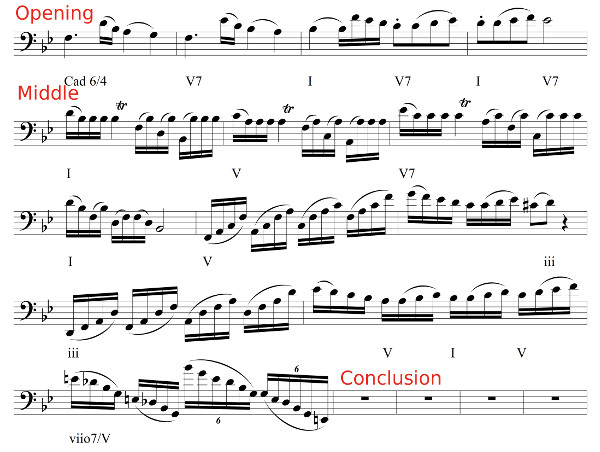
Now I need a little bit of music to take me from the D4 and get me to E4 in my diminished chord. Just repeating the last statement in the violin section in upward steps works great for this. Now let's hear how the whole thing sounds.
 Open full-size figure
07:16Vincent Igusa's Sequential Pattern
In Vincent's middle section, here is the sequential pattern he uses. It is repeated twice and then breaks off after the third time.
 Open full-size figure
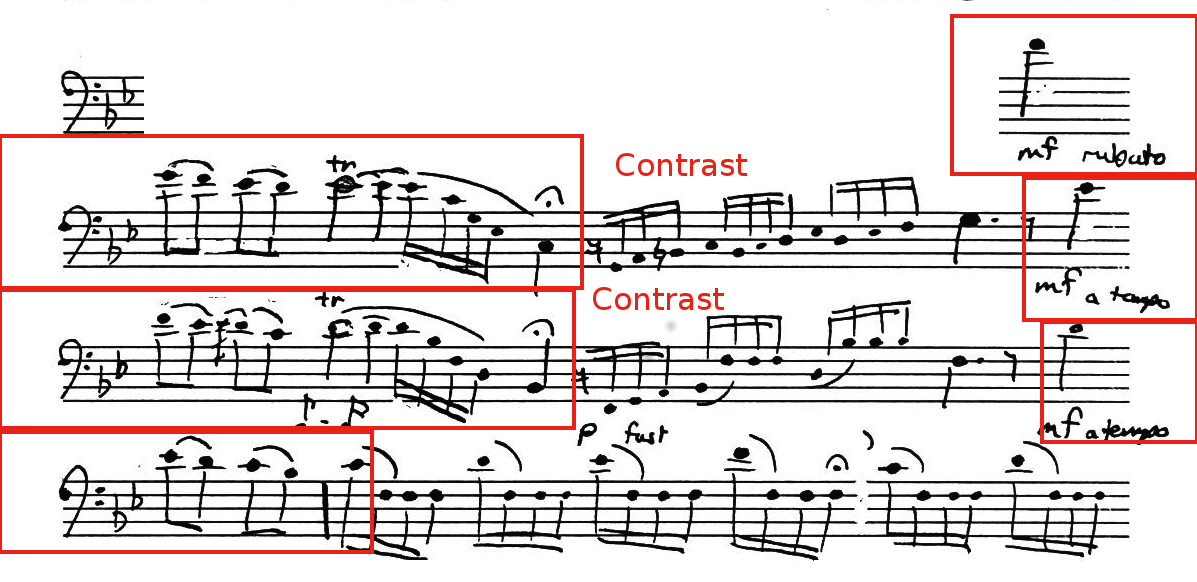
07:34Terry Ewell's Sequential Pattern
The sequential pattern in my cadenza is unusual due to the insertion of contrasting materials.
 Open full-size figure
07:43Additional Cadenzas
On https://www.2reed.net/Cadenzas you will find copies of the cadenzas by Vincent, some of my other students, and me. All of these are provided with the kind permission of the authors. I hope that these give you further ideas for your cadenzas.
08:16Final Encouragement
I hope that these discussions of how to write a cadenza for the Mozart Bassoon Concerto have been helpful for you. Be inspired! Take the challenge and write your own cadenza. Perhaps in the future I will be able to hear what you have written. I look forward to it!
08:52Closing Performance
Music: Vincent Igusa, bassoon, and Catherine Renggli, piano. Towson University Recital Hall, 20 June 2017.
Credits
- author Terry B. Ewell
- bassoon Vincent Igusa
- piano Catherine Renggli
- Artwork and Graphics by Terry B. Ewell
- Copyright 2015-22 by Terry B. Ewell.
- Copyright (c) 2018 by Terry B. Ewell. All rights reserved.