Practicing Weissenborn Study #17
Weissenborn Opus 8/2, Study #17 for advanced bassoon students. Using the alternate F# fingering. Stravinsky's healing. Guest performer Sojung Kwon. By Terry B. Ewell, Bassoon Digital Professor. BDP #125.
Comments
Weissenborn Opus 8/2, Study #17 for advanced bassoon students. Topics include: - Slurred eighth-note articulation - Breathing strategy - Alternate F♯ fingering - Thumb motion to B♭ - Stravinsky's healing Guest performer: Sojung Kwon By Terry B. Ewell, Bassoon Digital Professor. BDP #125 • www.2reed.net
The original transcript is available here.
Videos
Captions are unavailable. The complete transcript follows.
Chapters
Transcript
0:19Introduction
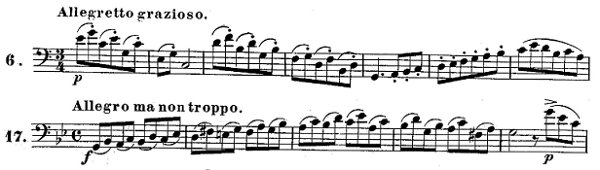
Welcome, this is Terry Ewell. In Study #17 Weissenborn does not give staccato markings at the end of slurred pairs. This is different from Study #6, where staccato marks are given with each pair of slurred notes.
 Open full-size figure
0:21Slurred Eighth Notes
Slurred Eighth Notes
0:47Breathing Strategy
Therefore, the eighth notes should be rather connected, and they should be separated only briefly with the tongue between the slurs.
0:59Section
You will notice in line 4 that I have indicated two breaths quite early in the phrase. This is in order to keep air in the lungs to complete the phrase and also to avoid large gaps when breathing is needed in line 5. Similar breathing choices are made later in the study as well.
1:09Dropping the Jaw to Breathe
I have mentioned before that the quickest way to breathe is by dropping the jaw rather than raising the head. I encourage you to practice this study breathing that way.
1:20Alternate F♯ Fingering
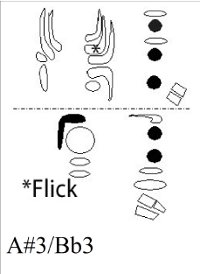
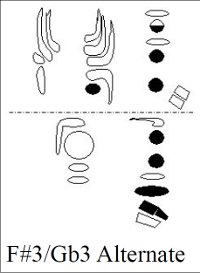
The alternate F♯ fingerings in line 7 help facilitate the movement to B♭3.
 Open full-size figure
 Open full-size figure
 Open full-size figure
1:36F♯ to B♭ Thumb Motion
There will be many examples in the Fifty Studies where those two notes (F♯ and B♭) are slurred. Leaping the thumb over the E key (the pancake key) will interrupt the slur.
1:48Section
Practice the motion from the little-finger F♯ to the thumb B♭ until you have mastered it.
2:06Reflection: Stravinsky's Healing
> "I sat down, removed the little bandage, felt the pain had suddenly stopped, and discovered that the finger was—miraculously, it seemed to me—healed." > > — Igor Stravinsky > > (Igor Stravinsky and Robert Craft, Dialogues and a Diary (Garden City: Doubleday & Co., Inc., 1962), p. 9.)
2:19Faith and Music
We saw in the last video that J. S. Bach's encounters with God are reflected in his music and in his study of the Bible. Igor Stravinsky's encounters with God occurred in different circumstances.
2:34Stravinsky's Conversion
Stravinsky gained great fame with his compositions based on pagan rituals and Russian folk tales during the 1910s. Later, in the mid-1920s, however, his spiritual life was transformed. Stravinsky stated that two events led to his faith in God: 1. A convincing answer to a private prayer. 2. The healing of his finger immediately before a performance of his Piano Sonata. These two experiences had such a profound effect on his life that he dedicated his next major orchestral work, Symphony of Psalms, to the glory of God.
3:17Recommended Reading
If you are interested in reading more about composers' encounters with God, I recommend Patrick Kavanaugh's The Spiritual Lives of Great Composers. It tells the stories of many musicians, both well known and obscure, who chose to follow the teachings of Jesus.
Credits
- author Terry B. Ewell
- composer Julius Weissenborn