Practicing Weissenborn Study #18
Weissenborn Opus 8/2, Study #18 for advanced bassoon students. Downward slurs. Practicing with rhythms that break pairings and create metric displacement. By Terry B. Ewell, Bassoon Digital Professor. BDP #126.
Comments
Weissenborn Opus 8/2, Study #18 for advanced bassoon students. Topics include: - Downward slurs - Register balance - Alternate F♯ fingering - Rhythms that break pairings - Metric displacement - Hearing God's voice By Terry B. Ewell, Bassoon Digital Professor. BDP #126 • www.2reed.net
The original transcript is available here.
Videos
Captions are unavailable. The complete transcript follows.
Chapters
Transcript
0:18Introduction
Welcome, this is Terry Ewell.
0:21Downward Slurs and Register Balance
Study #18 focuses on mastering two techniques that are especially challenging on the bassoon: downward slurs and register balance. On the bassoon it is natural to emphasize the lower note when slurring a large interval. However, these downward slurs should be performed without accenting the lower note. In fact, Weissenborn indicates that the upper note should receive the accent, allowing the lower note to resolve gracefully. In this study, the accents are produced with increased air support on the upper notes, followed by a diminuendo to the lower notes.
 Open full-size figure
1:15Alternate F♯ Fingering
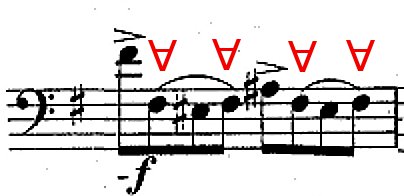
The alternate F-sharp fingering in line 7 helps facilitate the motion to B-flat 3. I mentioned the use of the little-finger F-sharp key in the previous study, and I hope you have adopted that technique.
 Open full-size figure
 Open full-size figure
1:35Rhythms that Break Pairings
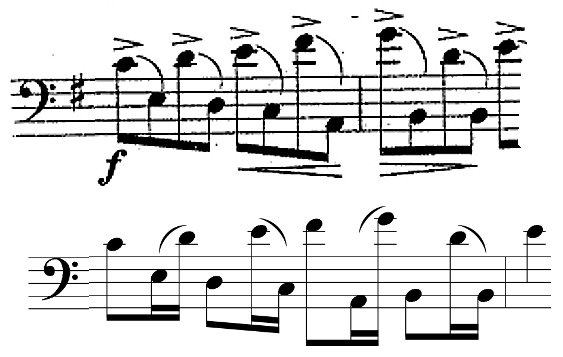
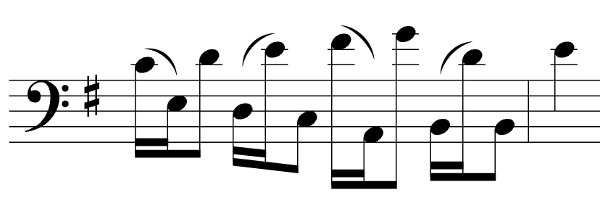
The second-to-last line in the study requires special attention. These large leaps involve awkward finger patterns. I recommend two practice methods here, as well as anywhere else they are needed in the study. 1) Rhythms that break pairings
 Open full-size figure
 Open full-size figure
2:13Practice Rhythms
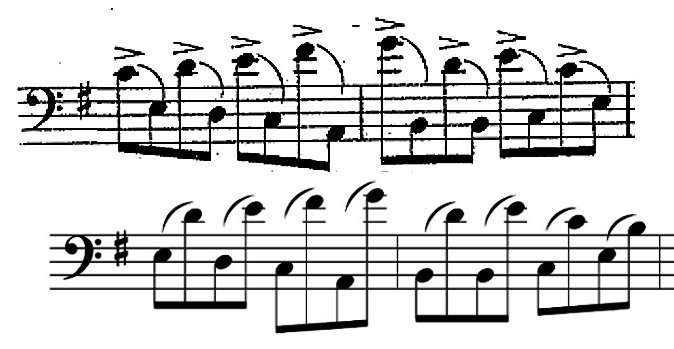
Practice both rhythm patterns: eighth notes followed by sixteenth notes, and sixteenth notes followed by eighth notes. 2) Metric displacement
 Open full-size figure
2:22Metric Displacement
Metric Displacement
2:40Reflection: "My Sheep Hear My Voice"
> "My sheep hear My voice, and I know them, and they follow Me." > > (John 10:27, NKJV)
3:04Discerning God's Voice
These are words that Jesus spoke about His followers—His sheep. In the previous video we saw that Stravinsky's transformation was due in part to an answer to prayer. He heard God's voice and chose to follow Him.
3:23Tone of Voice
So how does a person know whether it is the voice of God speaking or the voice of evil forces? In the next few reflections I summarize an article by Harry Leesment that has been helpful to me and to many others. 1. Tone of voice. God's Spirit is gentle and imploring. In contrast, evil forces are accusatory and belittling. Those other voices are harsh.
3:40Specific vs. Vague
2. Specific vs. vague. The Spirit of God points to specific actions you should take to correct your relationship with God and with others. The other voices tell you that everything is wrong and there is really nothing you can do to fix it. God directs you to a way out; the others insist there is no way to free yourself.
4:12Encouragement vs. Discouragement
3. Encouragement vs. discouragement. God's message encourages us to rely on His power rather than our own. The other voices attack people and leave them discouraged.
Credits
- author Terry B. Ewell
- composer Julius Weissenborn