Practicing Weissenborn Study #20
Weissenborn Opus 8/2, Study #20 for advanced bassoon students. Topics include thanks to student participants, double breath signs, marking whole steps, and stabilizing B♭3.
Comments
Weissenborn Opus 8/2, Study #20 for advanced bassoon students. Topics include: - Thanks to student participants - Double breath signs - Maintaining oxygen levels - Subdividing dotted-quarter rhythms - Marking whole steps - Stabilizing B♭3 - Alternate fingering for B♭3 - Holding the C flick key - Hearing God's voice (Part 3) By Terry B. Ewell, Bassoon Digital Professor. BDP #128 • www.2reed.net
The original transcript is available here.
Videos
Captions are unavailable. The complete transcript follows.
Chapters
Transcript
0:19Introduction
Welcome to Weissenborn Study #20.
0:23Thanks to Student Performers
I want to include my thanks to the students who have helped me with this project. Without their assistance recording the videos, I probably would not have been able to provide an edited performance video for every study. Originally, when I began this project, I did not intend to record a performance video for every study.
1:06Double Breath Signs
Even with their help, however, I did not have enough recording time in the hall or the endurance to play every note in all of the studies. For example, on the day I recorded the performance of this study, I also recorded fourteen other studies.
1:38Maintaining Oxygen Levels
In Study #20 I have indicated several double breath signs. These designate places where I need to inhale as much air as possible. The reason is not only to supply enough air for the lungs, but also to maintain oxygen levels that help sustain concentration. I find that I make more mistakes at the ends of phrases when my lungs have lower oxygen levels.
2:16Subdividing Dotted Rhythms
One important way to maintain good oxygen levels is to exhale the residual air from your lungs before taking a large breath. Therefore, when you begin the first line, do not completely fill your lungs. Expel most of your air while playing before taking the larger breath during the quarter rest in line one. Before the meno mosso, completely exhale before taking a deep breath. This is a key strategy for playing the long phrase all the way to the end.
2:53Marking Whole Steps
Students often rush the dotted quarter notes. Subdivide these dotted quarter notes. Take line four as an example. You can first practice by tonguing all of the eighth notes, and then perform the passage as written.
3:11Stabilizing B♭3
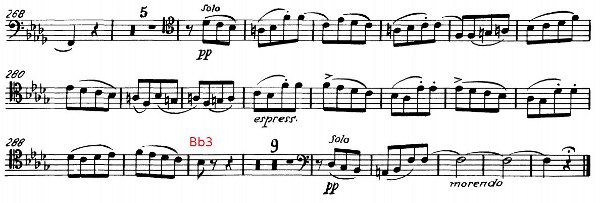
This study features chromatic scales ascending and descending. However, there are several places where the chromatic motion is interrupted by whole steps. One way to avoid mistakes is to mark those whole steps. I use square brackets above the notes.
 Open full-size figure
3:33Section
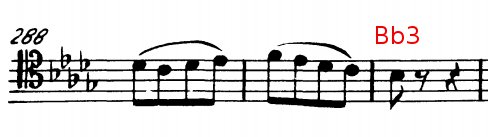
B♭3 is an unstable note on the bassoon, particularly at the end of a phrase where a diminuendo is required. For example, the famous solo in the second movement of Tchaikovsky's Fourth Symphony ends on this B♭. I will play the last three measures.
 Open full-size figure
 Open full-size figure
3:50Section
I add the D♭ key to help stabilize the note at the end of the Tchaikovsky solo. This alternate fingering also works for the last note at the end of the sixth line.
3:58C Flick Key in Meno mosso
In the meno mosso, hold down the C flick key for multiple notes. In the first measure this is done for C4, B3, B♭3, and A3.
4:12Reflection: The Spirit of Truth
> “…when He, the Spirit of truth, has come, He will guide you into all truth; for He will not speak on His own authority, but whatever He hears He will speak; and He will tell you things to come.” > > (John 16:13, NKJV)
4:31Hearing God's Voice (Part 3)
This is the third of three reflections on hearing God's voice. If you have not listened to the first reflection contained in the video on Weissenborn Study #18, I encourage you to do so.
4:46Discipline vs. Destruction
8. Discipline vs. destruction. God's Spirit disciplines us, and this makes us stronger. The adversaries seek to tear us down. Do not think that because God is full of love, He has no interest in correcting us and helping us grow. He is a good parent, not a neglectful parent.
5:10Reassures vs. Accuses
9. Reassures vs. accuses. These two words perhaps best describe the differences between God and the adversaries.
5:24Facts of the Word vs. Feelings
10. Facts of the Word vs. feelings. The Spirit of God brings forth the facts. The adversaries want our feelings to override the truth.
5:40Closing Prayer
I pray that you will listen to God's voice and have His blessings in your life.
Credits
- author Terry B. Ewell
- composer Julius Weissenborn