Weissenborn Study #32
Weissenborn Opus 8/2, Study #32 for advanced bassoon students. Subdivisions for better accuracy with rests. Drones vs. tuners, which is best for improving intonation?
Comments
Weissenborn Opus 8/2, Study #32 for advanced bassoon students. Subdivisions for better accuracy with rests. Drones vs. tuners, which is best for improving intonation? By Terry B. Ewell, Bassoon Digital Professor. BDP #139.
The original transcript is available here.
Videos
Captions are unavailable. The complete transcript follows.
Chapters
Transcript
0:19Tempo di Marcia
Welcome, this is Terry Ewell. Weissenborn marks study #32 tempo di Marcia, which means in the tempo of a march. Thus, this study should not be performed too fast.
0:38Rhythmic Accuracy with Rests
The most common rhythmic problem in the study occurs with the eighth note, sixteenth rest, and sixteenth note rhythms. Often this is rushed like this: Example of rushing m. 2
 Open full-size figure
1:00Hearing Sixteenth-Note Subdivisions
The key to performing this correctly is to hear the sixteenth note subdivisions in your mind while playing it. For instance, I will play what I hear in my mind: Example with sixteenth note tonguing.
1:26Section
I then think of the sixteenth notes when I perform: Example not rushing.
1:42Drones versus Tuning Machines
Let's return to our work with drones. Let me ask you two questions. "Is it better to work with a tuning machine or with drones?" "Which method is the best way to develop good intonation?" Picture of tuning machines and apps.
2:01Why Drones Improve Intonation
While I find a tuning machine of some value, practicing with drones is by far a superior way to improve your intonation. Tuning machines (tuners) train your eyes, but drones train your ears to adjust the intonation correctly. When you perform with others, you must use your ears to adjust your pitch not your eyes.
2:28Daily Intonation Practice
I find that students often practice daily on improving their fingering technique so that they can play faster. Rarely, however, do I find students who practice their intonation every day so that they play more in tune. Why don't you be someone special? Make working with drones a part of your daily routine!
2:53Free Drones
I have free drones available for you on my website: http://www.2reed.net/
2:58Measure 1 and the Bassoon Registers
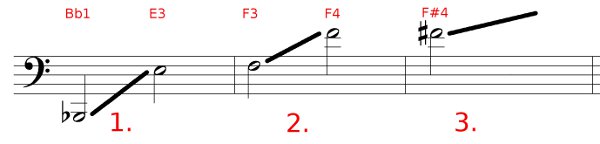
Let's do some work on measure 1. In Weissenborn studies #28-30 I presented information on tuning with changes in vowels and also I presented the illustration of the three bassoon registers.
 Open full-size figure
3:16D Major Arpeggio across Registers
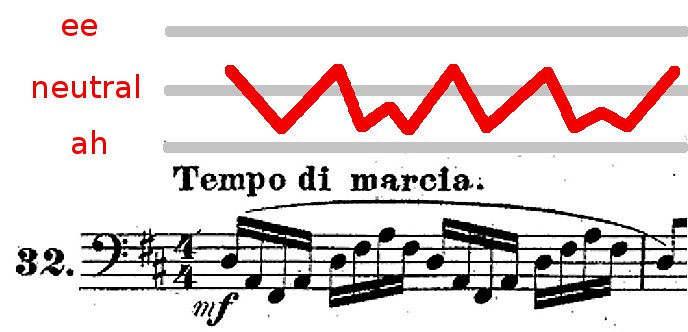
In measure 1 the D major arpeggio takes us through a portion of the first bassoon register and then crosses over to the second bassoon register. Let me explain the changes in vowels in another illustration.
 Open full-size figure
3:32Vowel Movement and Tongue Position
Above the music I have made a chart that shows the vowel movement when I perform this music. The "ee" vowel places the tongue more toward the roof of my mouth. The "ah" vowel moves the tongue backwards and downwards.
3:51D3, A2, and F#2 Vowel Positions
D3, the first note, is slightly above a neutral vowel position for me. I don't quite use the fully raised "ee" vowel, but I am tending in that direction. As I move to A2 and then F#2 I move my tongue towards the "ah" vowel. F#2 has more "ah" tongue position than A2.
4:18Crossing from D3 to F#3
The motion from D3 to F#3 requires a sudden vowel movement. I must rapidly change from almost "ee" to very close to a full "ah" vowel during the change of the sixteenth note. In addition to vowel adjustments, I also slightly move the position of my jaw, my embouchure.
4:42Slow Example
Here is the example played slowly. Example.
5:10Using the Ear to Guide Tongue Placement
How do I determine the exact placement of my tongue? I use my ear to guide me. I am always seeking a full, rich tone with good intonation. In addition, I try to have the timbre or sound quality of the notes match each other. ------------------------------------------------------------------------ # REFLECTION
5:28Reflection: The Peace of God
... and the peace of God, which surpasses all understanding, will guard your hearts and minds through Christ Jesus. (NKJV, Philippians 4:7)
5:39Prayer and Relief from Anxiety
In the last reflection I discussed anxiety and how prayers to God can relieve worries. Here is the promise that God will provide relief.
5:52Faith, Prayer, and Peace
When I pray to God I have faith that He will hear my prayers and provide relief. He often provides a calming presence to my spirit that gives me peace. I don't understand how this works with my mind, but I experience the reality of His power.
6:09God's Peace in Times of Anxiety
I don't know the worries and anxieties that you are facing at this moment. I do know, however, that God is willing and able to grant you this peace when you go to Him in prayer.
Credits
- author Terry B. Ewell
- composer Julius Weissenborn