Weissenborn Study #33
Weissenborn Opus 8/2, Study #33 for advanced bassoon students. Suggestions for fingerings. A further discussion on where to breathe. How to lightly tongue.
Comments
Weissenborn Opus 8/2, Study #33 for advanced bassoon students. Suggestions for fingerings. A further discussion on where to breathe. How to lightly tongue. By Terry B. Ewell, Bassoon Digital Professor. BDP #141.
The original transcript is available here.
Videos
Captions are unavailable. The complete transcript follows.
Chapters
Transcript
0:19Introduction
Welcome to this video on Weissenborn study #33. I am Terry Ewell.
0:26Three Fingerings for C#4
I play most of the notes on the bassoon with a single fingering, regardless of the dynamics of the note. C#4, however, is an unusual note because I often make use of three fingerings.
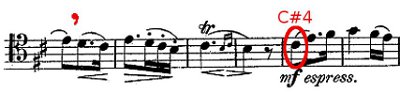 Open full-size figure
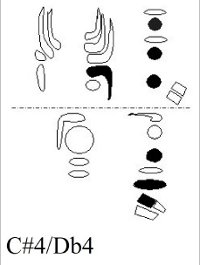
0:42French C#4 Fingering
My standard fingering for C#4 is the "French" fingering. I choose this as my regular fingering because it is louder than the "fast" fingering and uses fewer fingers than the "full" fingering. Fewer fingers down allow for quicker movements.
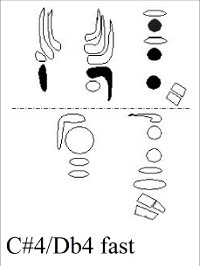
0:59Fast C#4 Fingering
The "fast" or left hand only fingering is used for the faster passages. For many Americans this is their standard fingering.
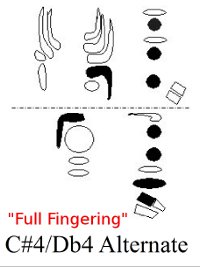
1:14Full C#4 Fingering
The "full" fingering provides a beautiful tone, and that is one I choose for lyrical and slower passages such as given in this study in the first four lines. I use the other two fingerings later in the study: the French C# when I want more resonance and the fast C# when the passage is difficult. I have not marked any of the C#s as alternate fingerings here so you will need to experiment with what works best for you.
 Open full-size figure
 Open full-size figure
 Open full-size figure
1:44Turn Fingerings in Line 1
I play the turn in line 1 measure 7 with normal fingerings. However, you might find it easier to use these fingerings as an alternative. In any case, you should remember these fingerings for trills and shakes.
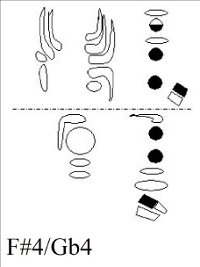 Open full-size figure
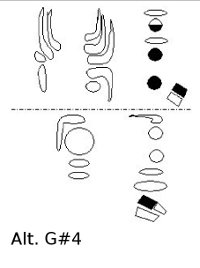 Open full-size figure
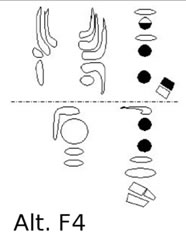 Open full-size figure
2:03C#4--D4 Trill
The C#-D4 trill in line 2 is fingered like this:
 Open full-size figure
C#4--D4 Trill, continued
Notice that I start with the full C# fingering then release the C# key and raise my left third finger. Then I trill the left third finger.
2:30Where to Breathe
In study #9 I presented reasons for when and where to breathe. Line 3, measure 1 is another interesting case study. I have heard many students make this choice, breathing after B3 on the bar line.
 Open full-size figure
Where to Breathe, continued
The B3 does sound as if it is a resolution from the F#4. However, this is a musically poor choice! Let me now explain.
3:02Relationship between the Four-Bar Phrases
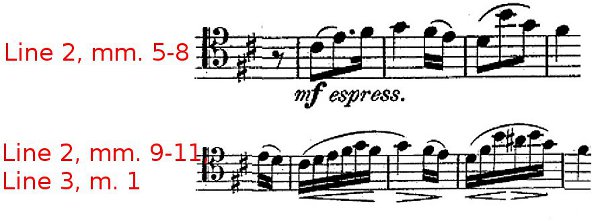
There is an important relationship between line 2, measures 5-8 and the following four measures ending with F#4 in line 3. These two four bar phrases are related. The second four bar phrase is an elaboration, and ornamentation of the first four bars.
3:25Comparing the Two Phrases
Here are the first two measures of the two phrases.
 Open full-size figure
3:42Section
Here are the second two measures of the two phrases.
3:58B3 as a Pickup
Now, can you hear how they are related? The lower line in the example is an ornamentation or elaboration of the top line. Therefore the breath needs to come in the same place---after F#4. Thus, in line 3, measure 1 the B3 is a pickup to the next phrase.
 Open full-size figure
4:23A Tempo and Phrase Structure
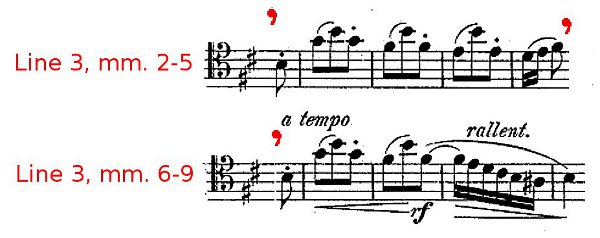
Weissenborn further indicates this musical understanding by placing the "a" of a tempo immediately over the B3 in line 3, measure 5. He indicates that this B3 belongs as a pickup to the next phrase. You can clearly see the beginning of the phrase at the a tempo is identical to the prior phrase start. This should thus be phrased in the same way.
 Open full-size figure
4:54Caesuras, Tempos, Mordents, and Trills
I will not comment on "rf," the caesuras, and tempos leading up to the fermata since I have discussed these in other videos. You can also observe how I present them in my performance in this video. I need to give you fingerings, however, for the mordents and the trill.
5:12D4--E4 Mordent
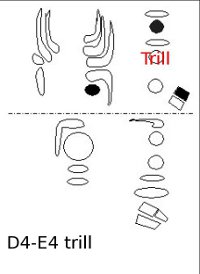
In line 6 the mordent on D4 to E4 is best fingered like this. The addition of the Eb resonance key gives a fuller sound to E4.
 Open full-size figure
5:30B3--C#4 Mordent
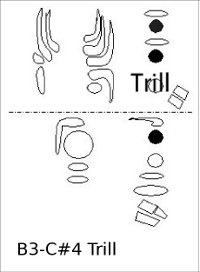
In line 6 the mordent on B3-C#4 is the standard trill fingering for those notes.
 Open full-size figure
5:37E4--F#4 Trill
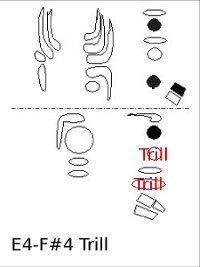
In line 10 on the fermata the trill from E4-F#4 is fingered like this:
 Open full-size figure
5:45Light Tonguing at the Corner of the Reed
Last of all, you might need to lightly tongue the slur to A#2 in line 4. If you choose to do this, don't tongue the center of the reed, rather tongue a corner of the reed. This will make the articulation less noticeable and still help the note to respond. Tonguing the corner of the reed yields a more legato articulation than tonguing in the center of the reed.
6:12Flicking for Clean Responses
I assume that you are correctly flicking the articulated notes for A3, B3, Bb3, and C4. All your notes need to start cleanly. In line 12, the downward slur from E4 to A3 comes out best by flicking the A key. If you need to review flick keys please see studies 3 and 4.
 Open full-size figure
Flicking for Clean Responses, continued
------------------------------------------------------------------------ # REFLECTION
6:40Proverbs 18:24
A man who has friends must himself be friendly. (NKJV, Prov. 18:24)
6:45The Importance of Making Friends
The importance of making friends should not be underestimated in the music industry. It is often people who know you who recommend you for jobs. During the interview process for the first university where I was hired there was a person on the search committee who knew me from our days in a youth orchestra. His advocacy was important for me getting the chance to interview for the job. This was the job that started my full-time academic career.
7:17Auditions, Interviews, and Professional Relationships
It is usually the case that when you interview or audition for a bassoon position in the USA, your committee will be comprised of non-bassoonists. For instance, when a university replaces a bassoon professor position, that bassoon teacher is not on the committee. The committee may contain other woodwind teachers, or performers, or professors or staff from other fields. Remember that your friendships should go out to people who perform different instruments or do other things in music. Be friendly to many people, not just those who play the bassoon.
Credits
- author Terry B. Ewell
- composer Julius Weissenborn